Opening
Jannis (organiser) Not recorded
Jannis opened the day and set the frame. Not recorded.
Lessons from the front lines of AI adoption
Liam Ottley Confirmed - schedule + slides
Recording started 10:13; the morning ran about 25 minutes late and the 10:45 break absorbed it.
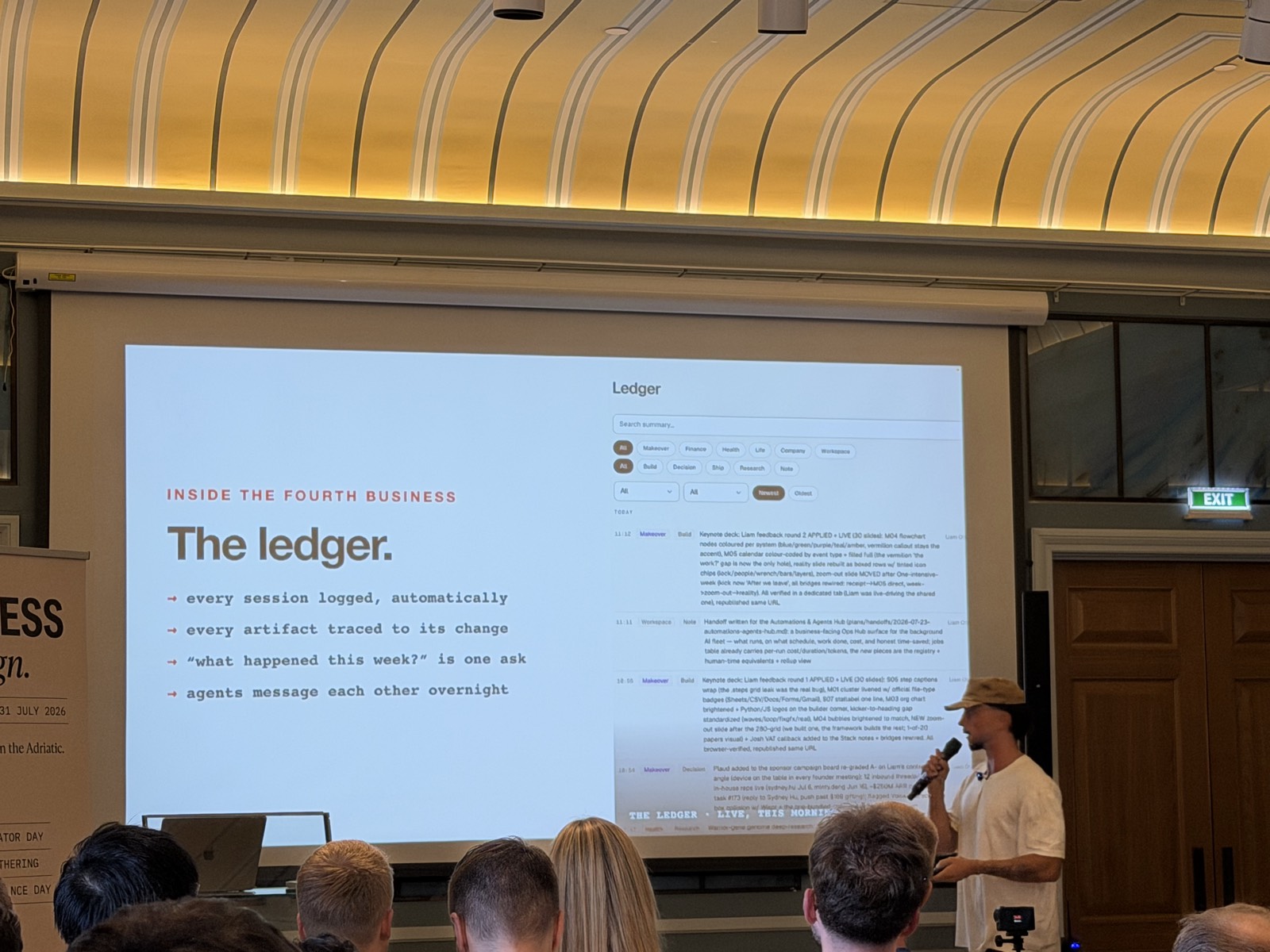
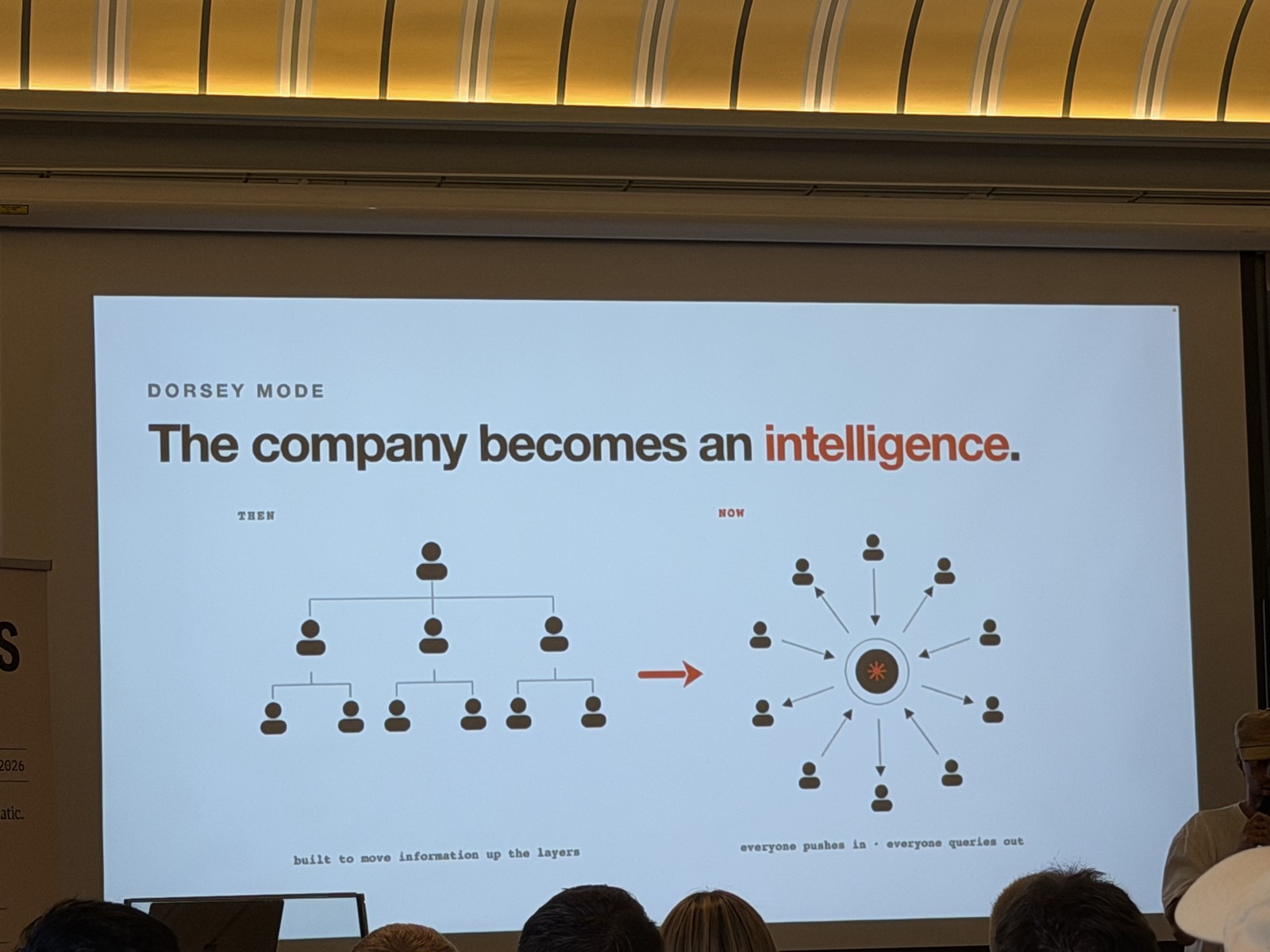
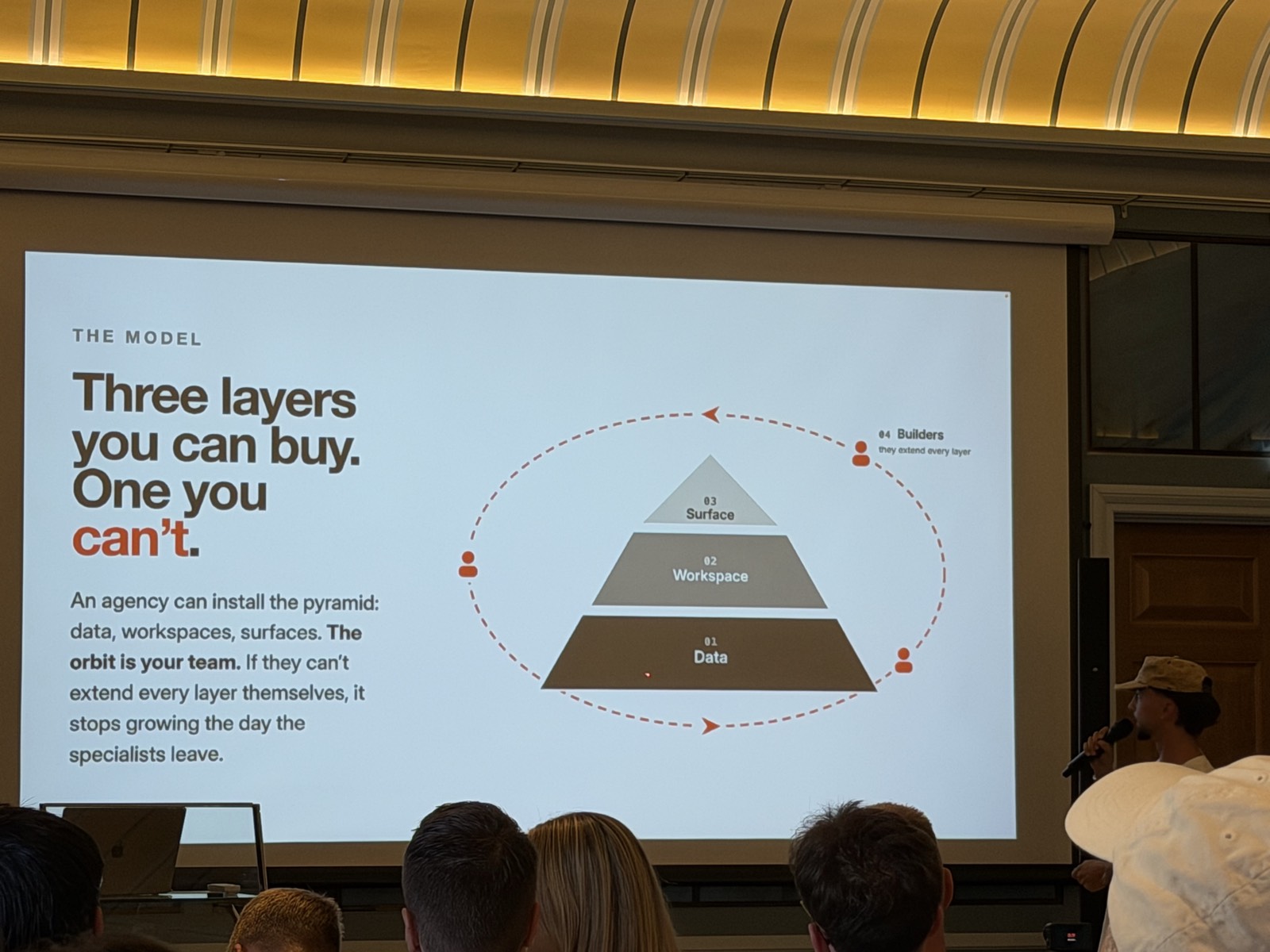
The Morningside AI founder walked five common AI-adoption mistakes drawn from three recent "AI Makeover" clients, and pitched his fix: an "AI workspace" where non-technical staff build their own tools with a coding agent. Attendees were handed a starter workspace zip - the same shape as a Limitless AIOS install.
Key takeaways
- Five mistakes: scattered data AI cannot reach; no centralised AI strategy; treating AI as a developer-only job; rigid automations on unstable processes; work invisible outside meetings.
- Skills vs automation rule: flexible skills for unstable processes; rigid automation only where nothing will change within ~6 months. Worked example: an accounting firm's working-papers process cut from ~1 hour to ~15 minutes (UNVERIFIED).
- The "Ledger": every piece of work, human or agent, continuously logged so managers see progress without meetings - functionally the AIOS HISTORY.md + dawn-commit pattern with a sellable name.
- Delivery model: the "AI Makeover" - an intensive ~1-week setup ("seven months of progress in seven days"), then the client's team self-manages. Positioned against 6-12 month agency engagements.
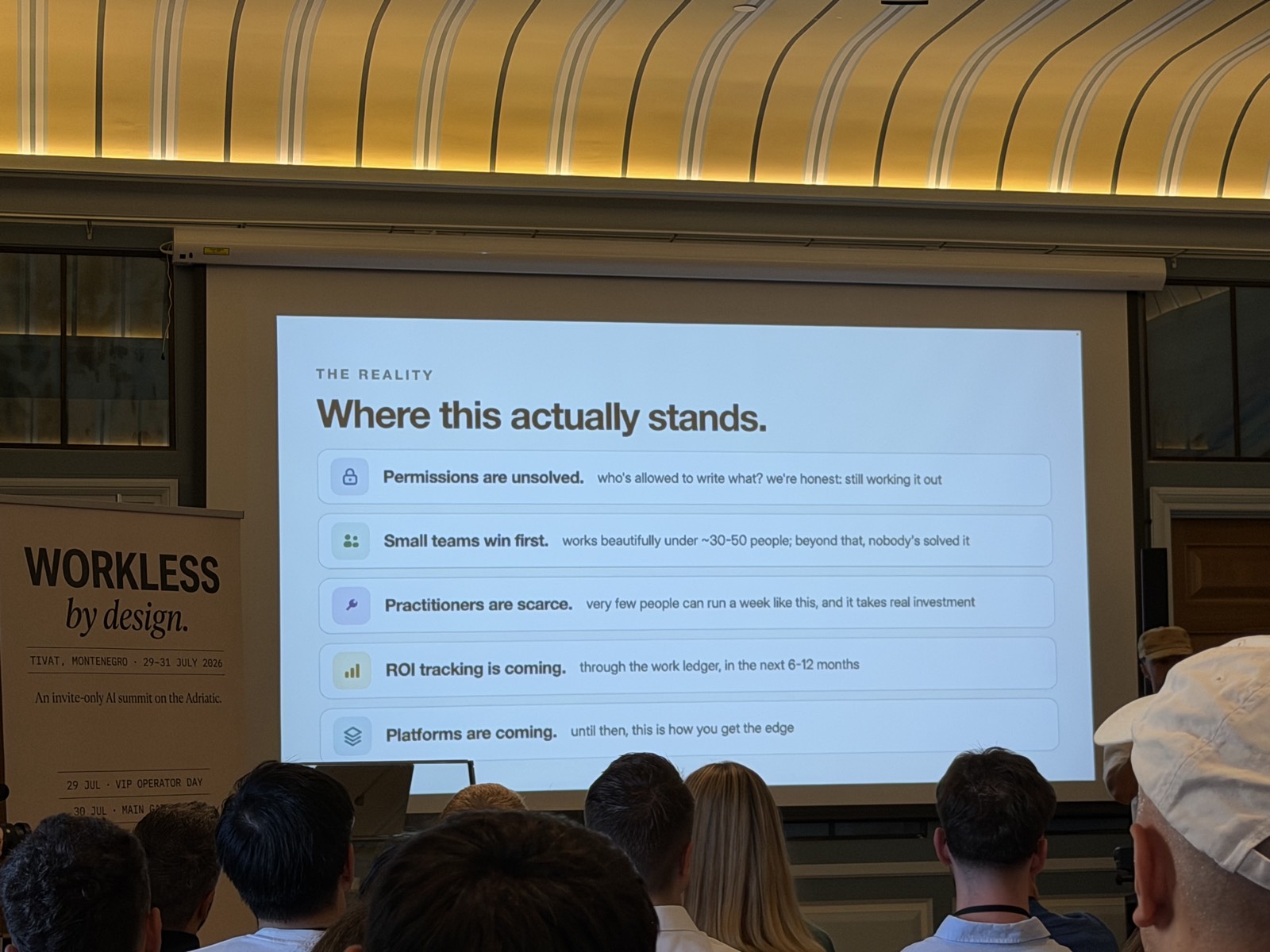
- Small teams are winning right now: enterprises are slowed by security and permissions; open flexible systems favour SMBs.
Competitive intelligence first: the biggest audience-holder in the space now sells a near-identical install. Sharpen differentiation (retainer relationship, adviser vertical, five-layer depth, the course) and weigh the intensive-week delivery format. His handout zip is in the KB resources folder.
Slides captured (5)
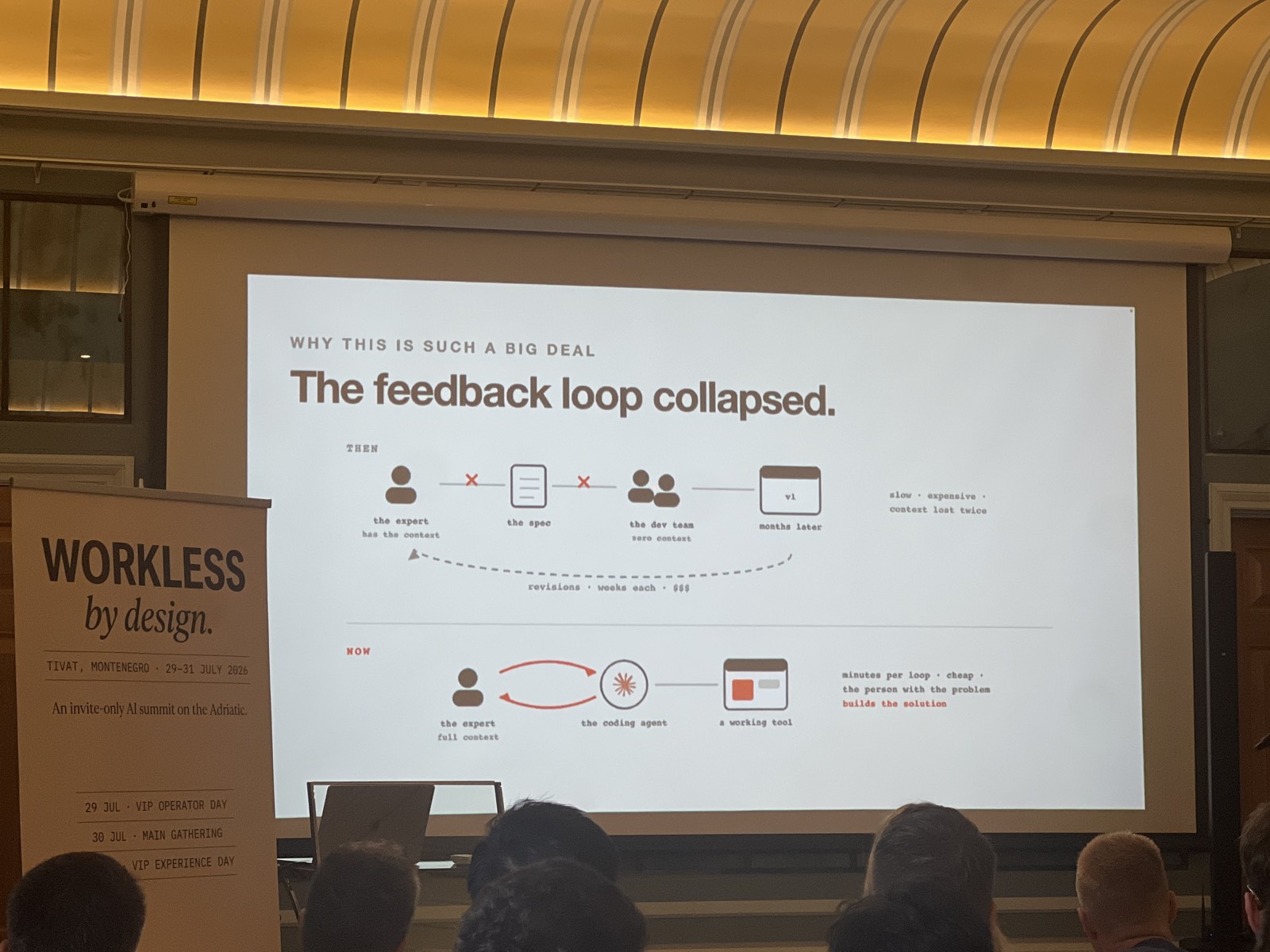
Mastering agentic workflows
Mark Kashef Confirmed - schedule
The deck itself never names the speaker; the name rests on the schedule slot. The debrief filed this as the "AIOS framework / rot" talk.
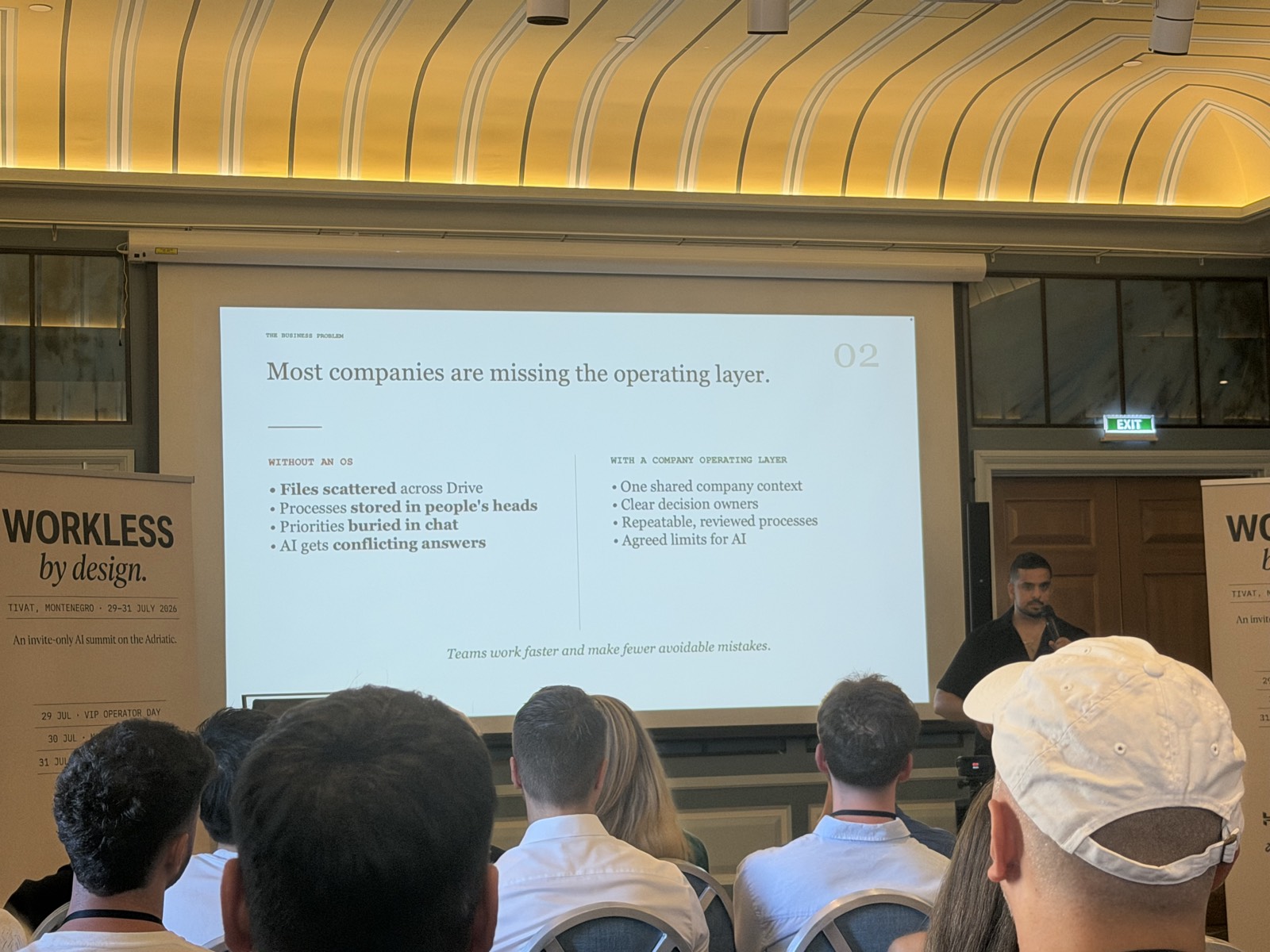
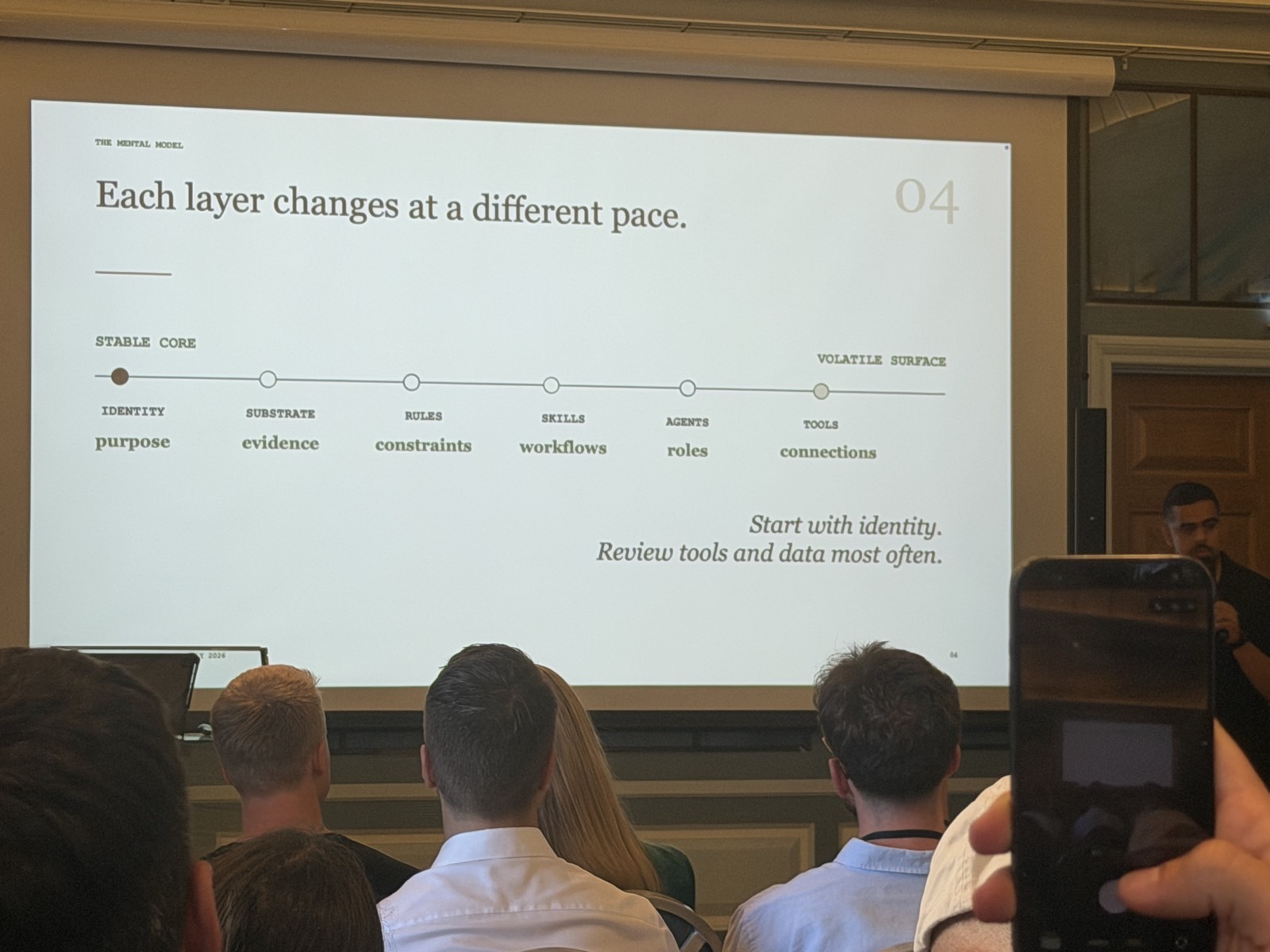
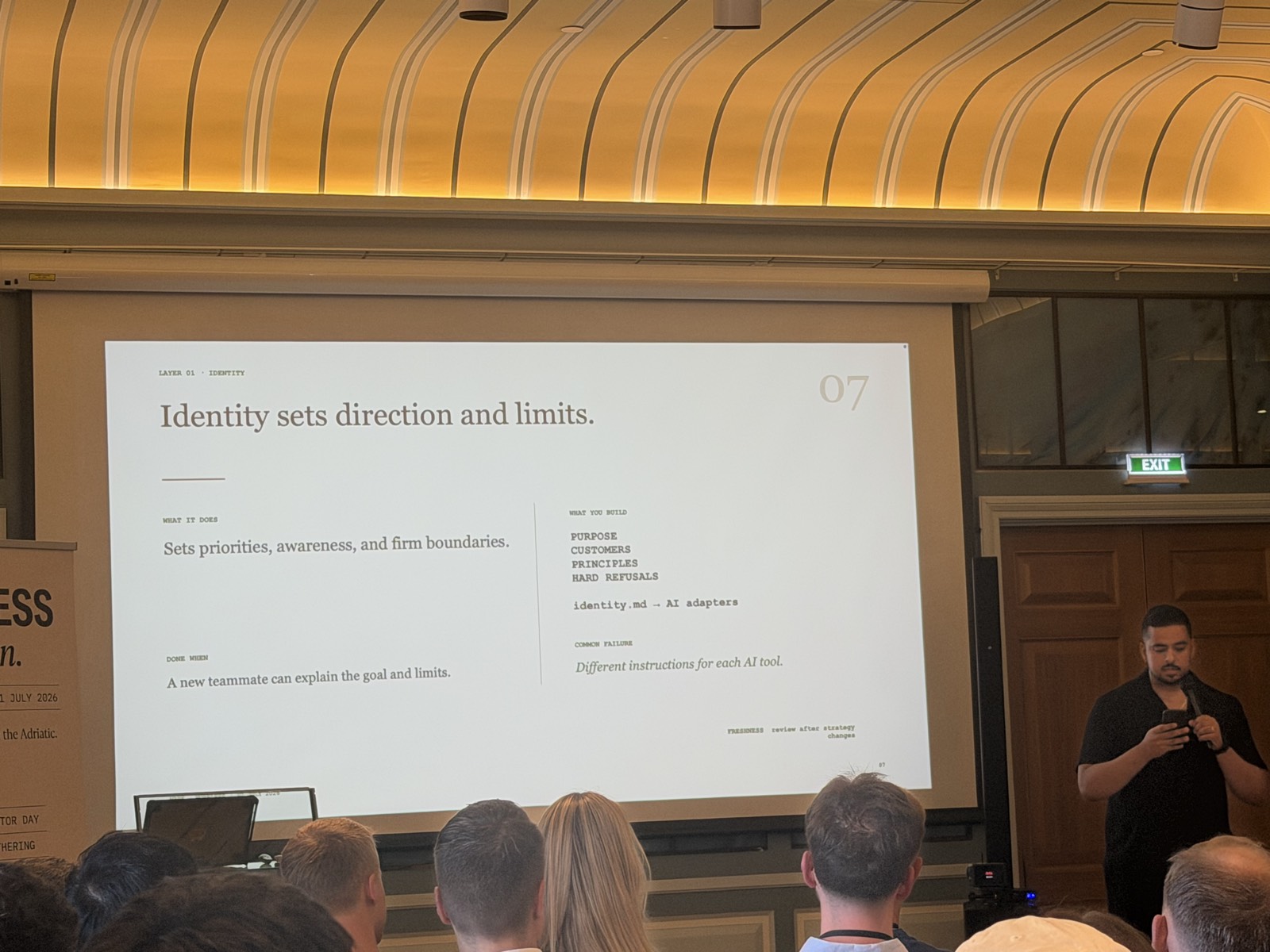
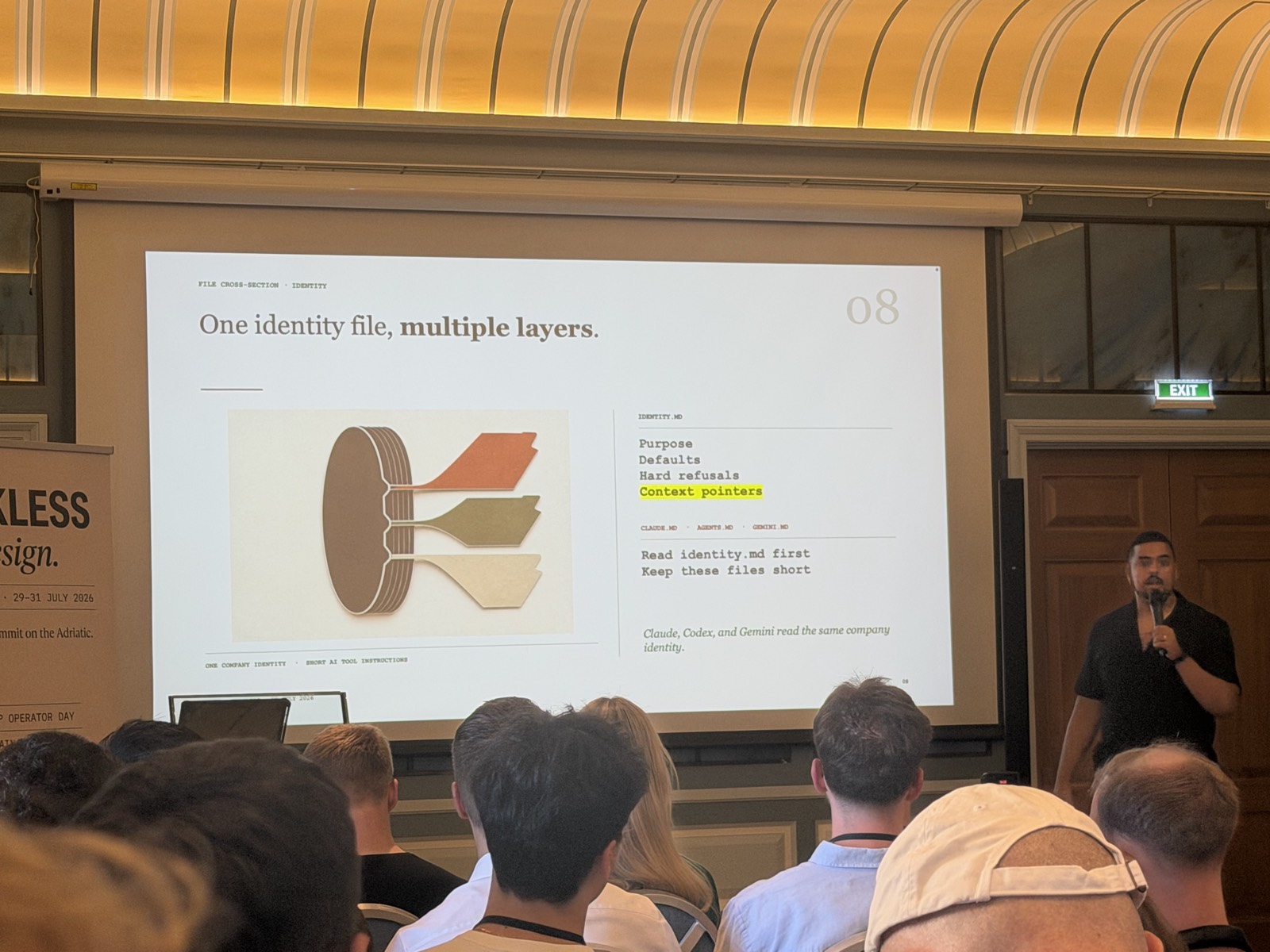
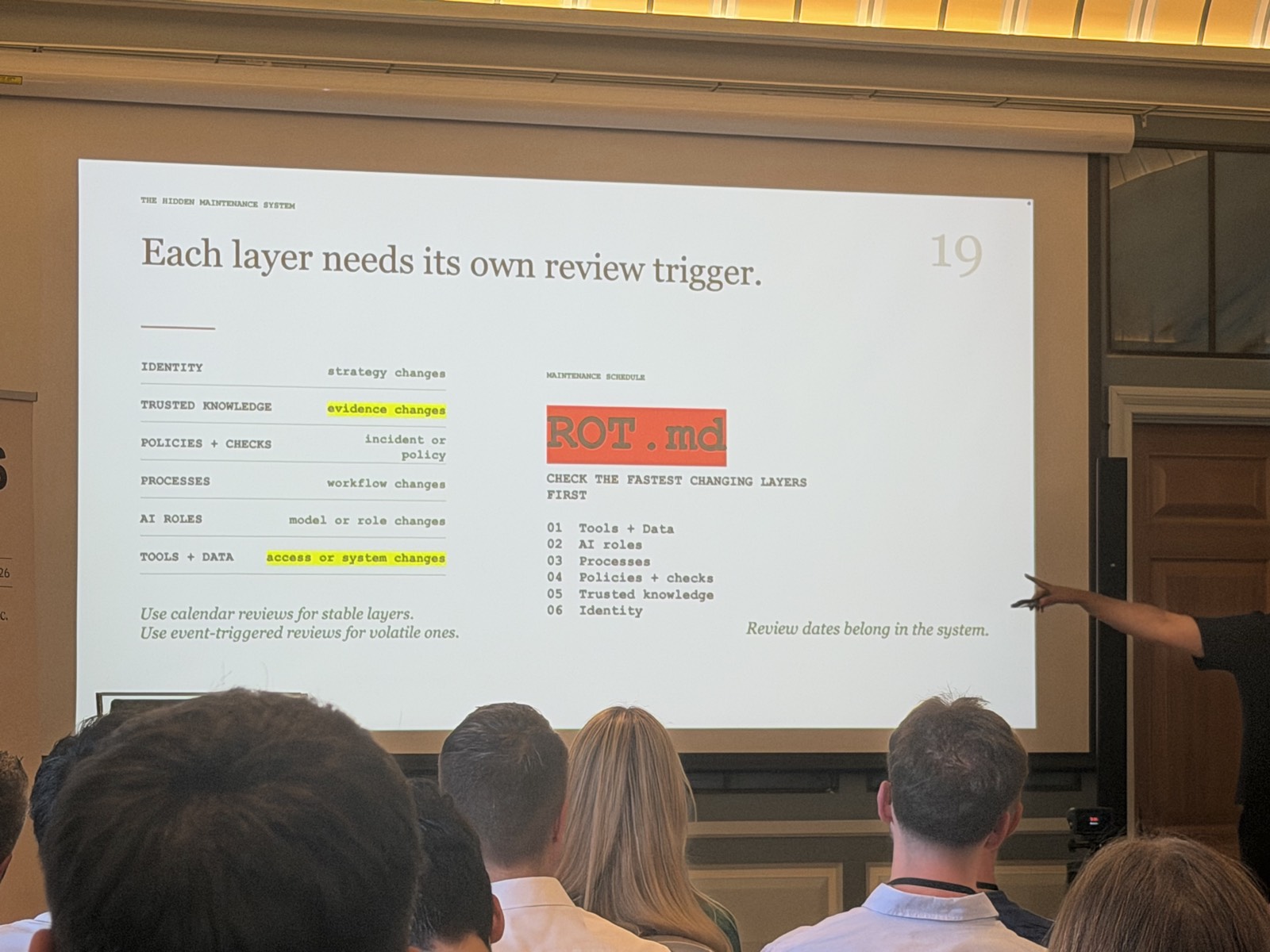
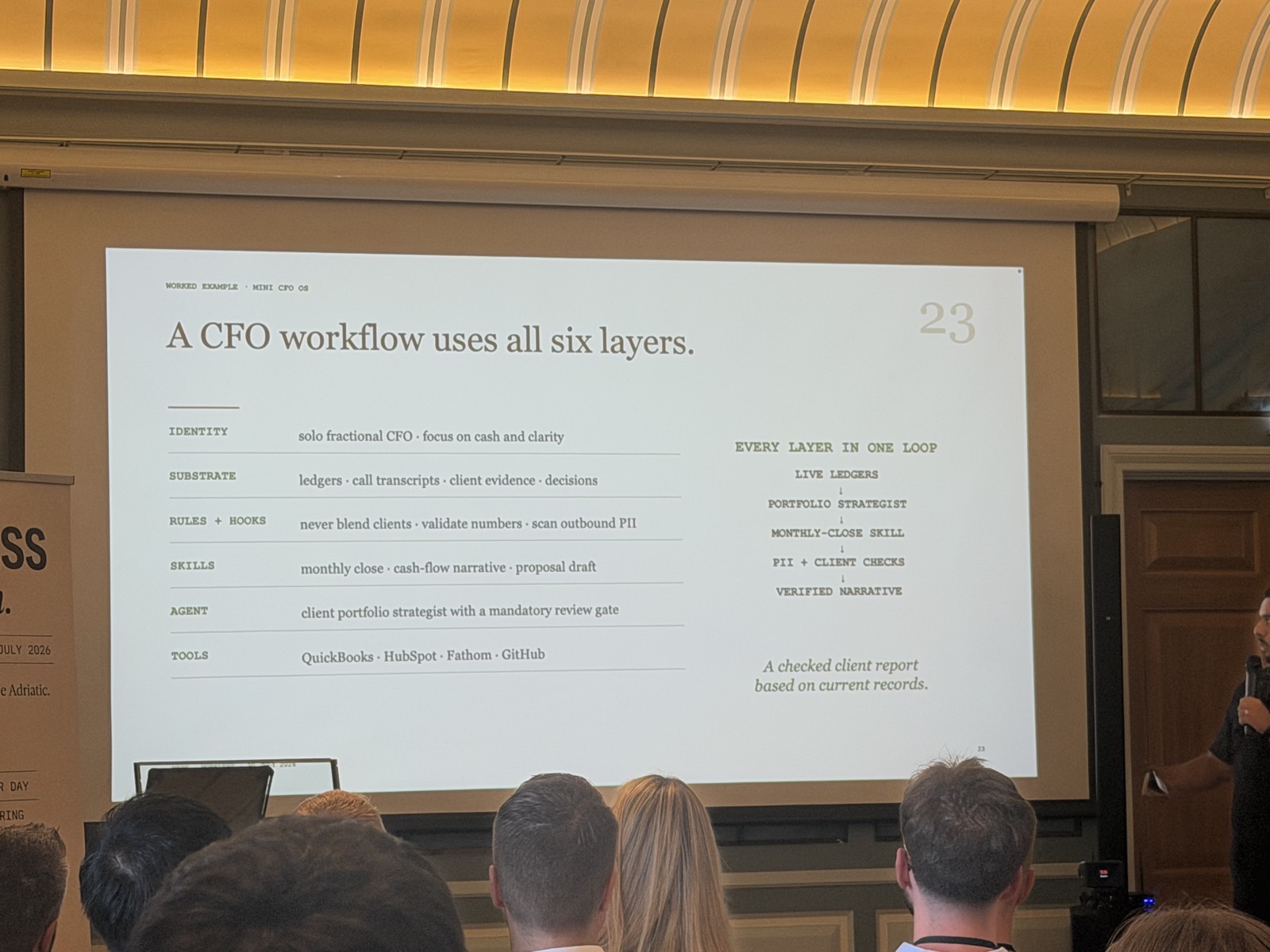
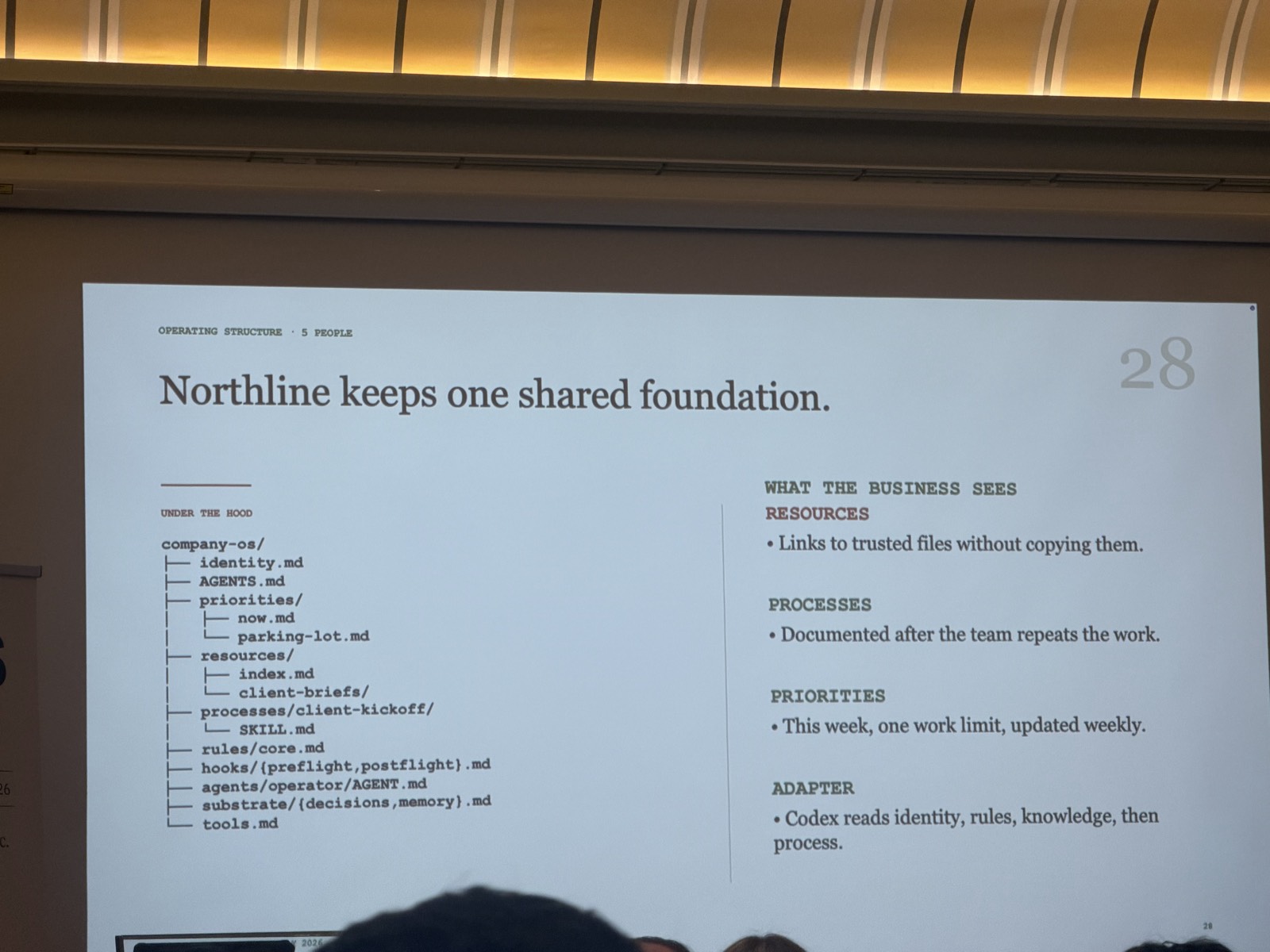
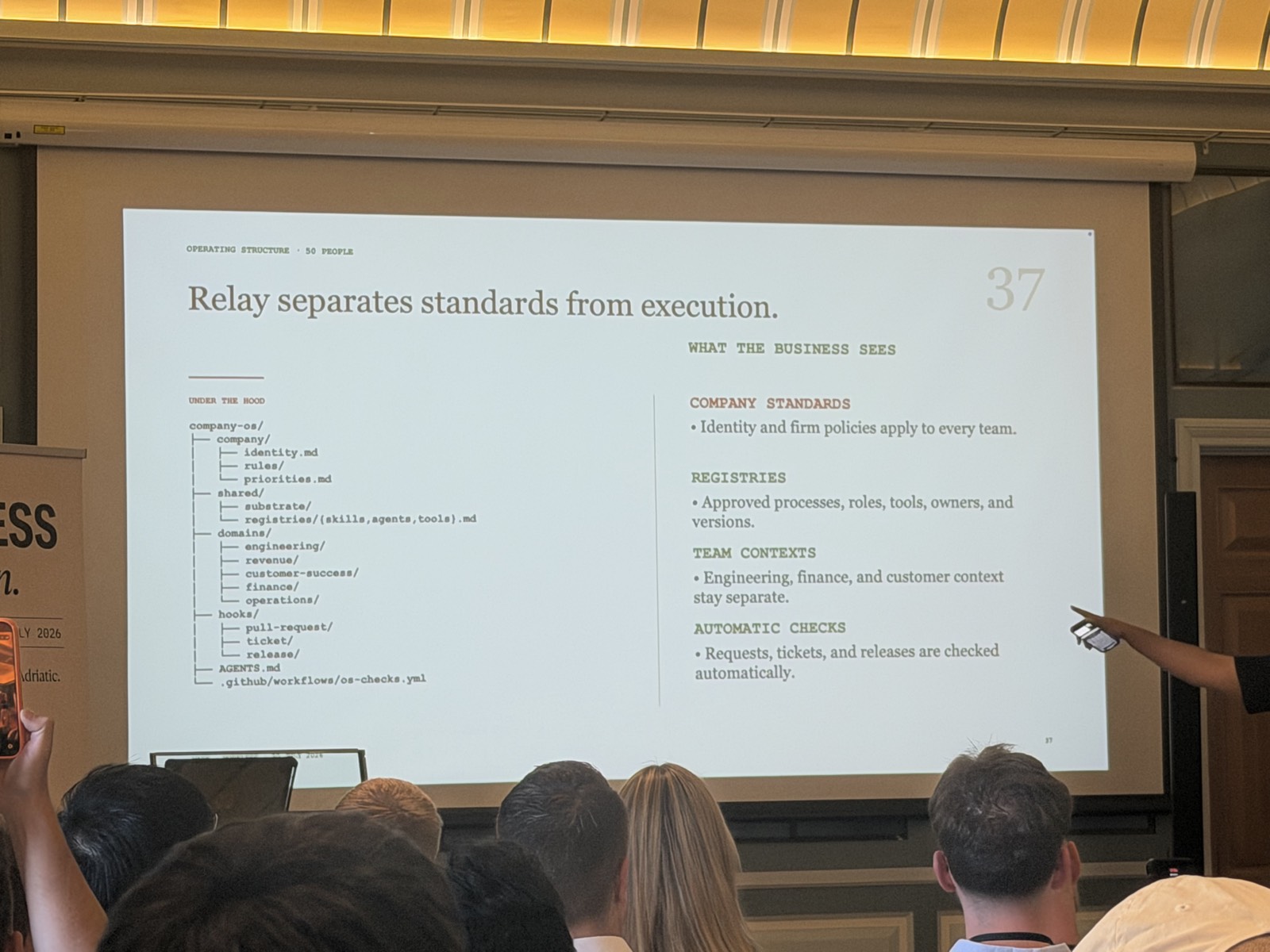
A layered AI-operating-system architecture and how it scales from 5 to 1,000 people: identity at the centre, then substrate, rules, hooks (the only deterministic layer), skills and connections. The commercial core was "rot": an OS starts becoming obsolete the minute it is built, which is the argument for the retainer.
Key takeaways
- Layer model: identity (changes ~yearly, includes a librarian index of file paths), substrate (durable files), rules (change often), hooks (when X then Y, 100% of the time), skills/workflows, connections.
- "Rot": he keeps a WAT.md cataloguing every file and process with its expected obsolescence window per layer. "Plumbing is the most profitable thing in AI."
- Hooks as compliance: he spent a month hardening hooks for one client so wrong-client data could never route to a wrong-client surface - the blast-radius argument for regulated companies.
- Rollout by size: 5 people = NOW vs BACKLOG; 15 = AI stewards per team, department by department starting revenue-adjacent; 50+ = departmental playbooks and information gating; 1,000 = hardened hooks, strict governance.
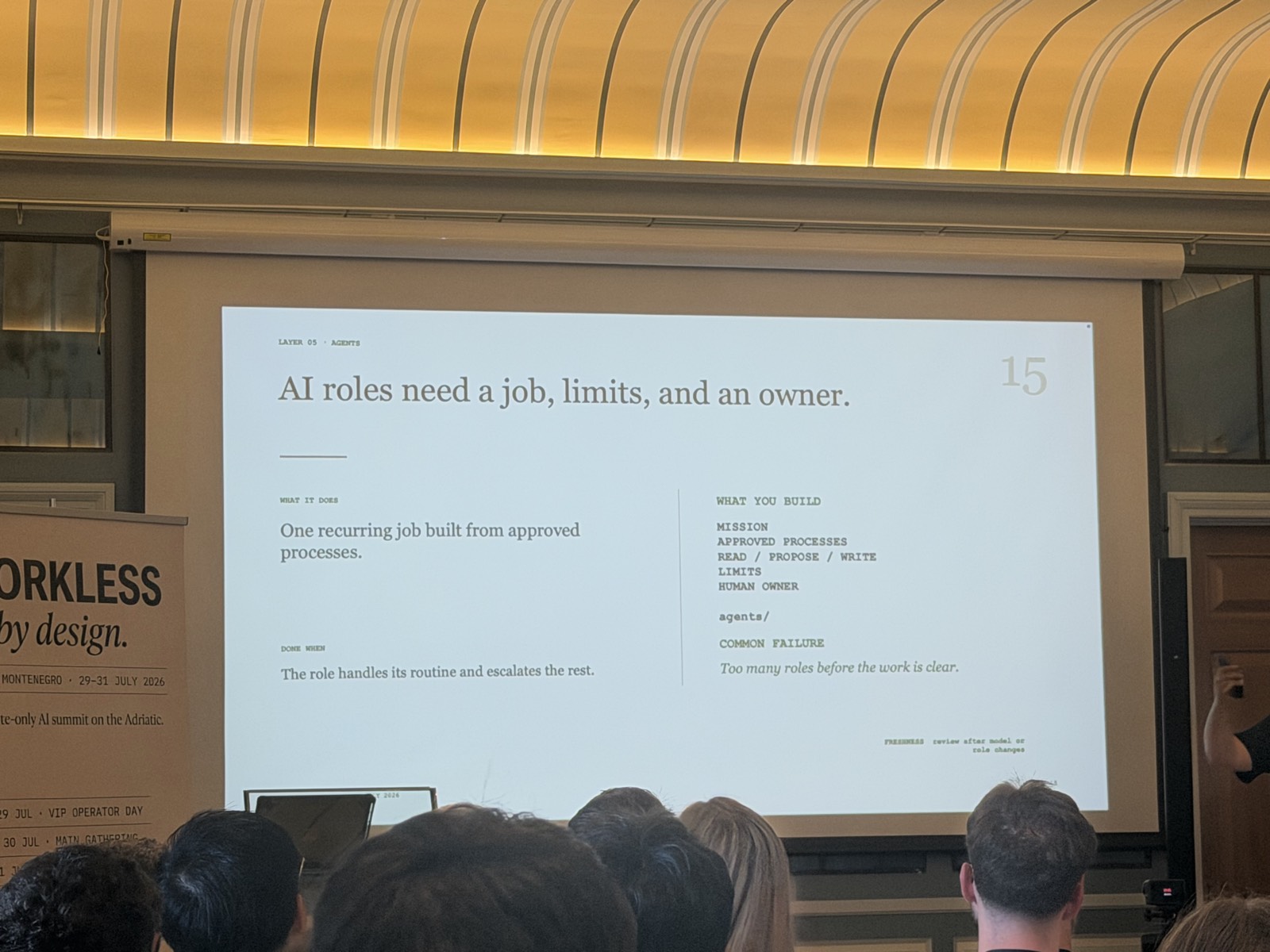
- Agent-hiring philosophy: an agent is a job; start with ONE, split only when scope gets weird - LLM errors cascade.
- Six-month skill purge (citing Claude Code's creator): delete skills and CLAUDE.md detail every ~6 months; old scaffolding handicaps newer models.
The sharpest retainer justification heard yet: adopt the rot/plumber framing in sales copy and the course, consider a rot-register in the client template, and fold hooks-as-compliance into the Liberty pilot narrative (POPIA).
Slides captured (9)
ClickUp takes the stage
Chris Cunningham (co-founder, ClickUp) Confirmed - schedule
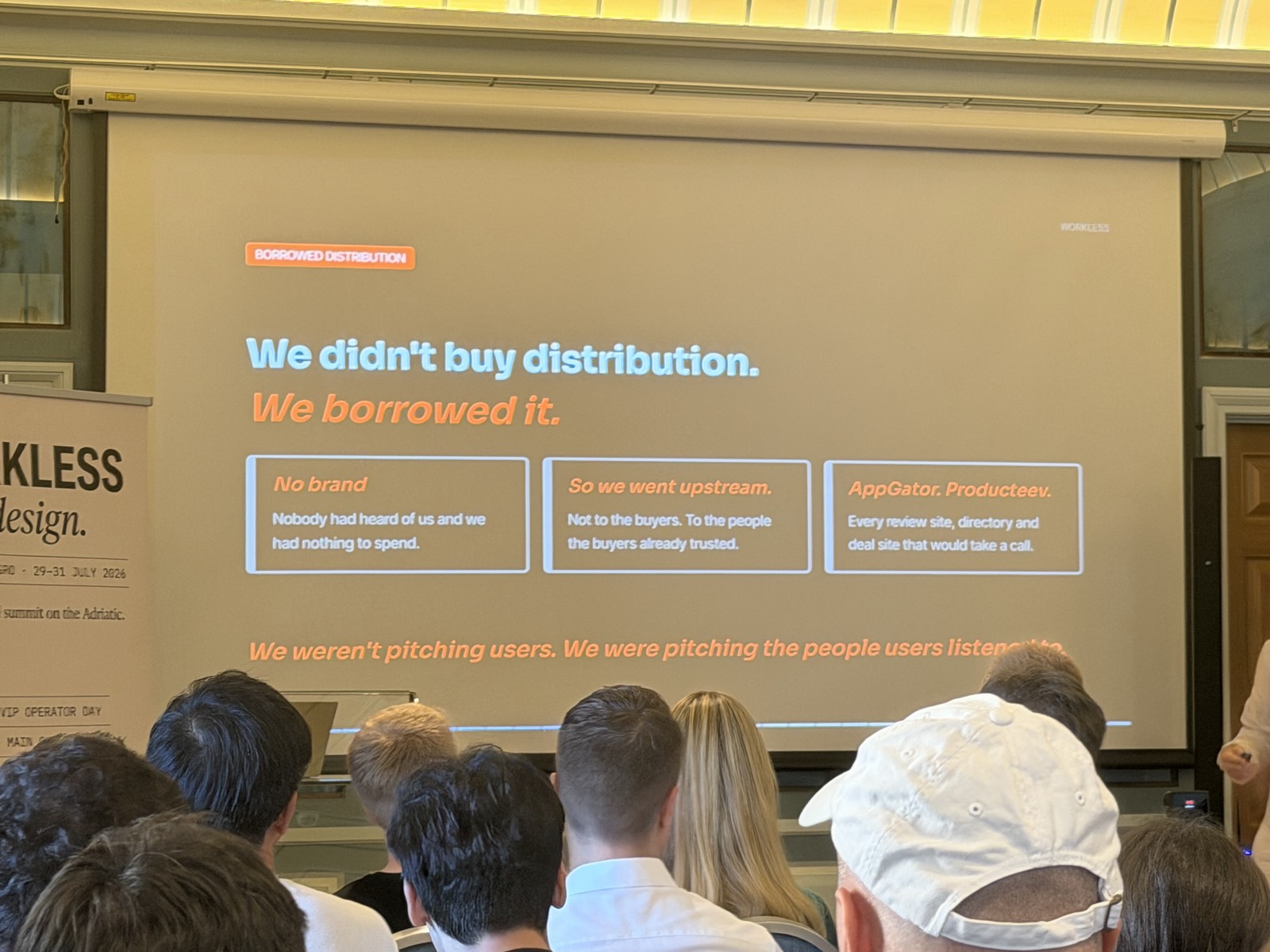
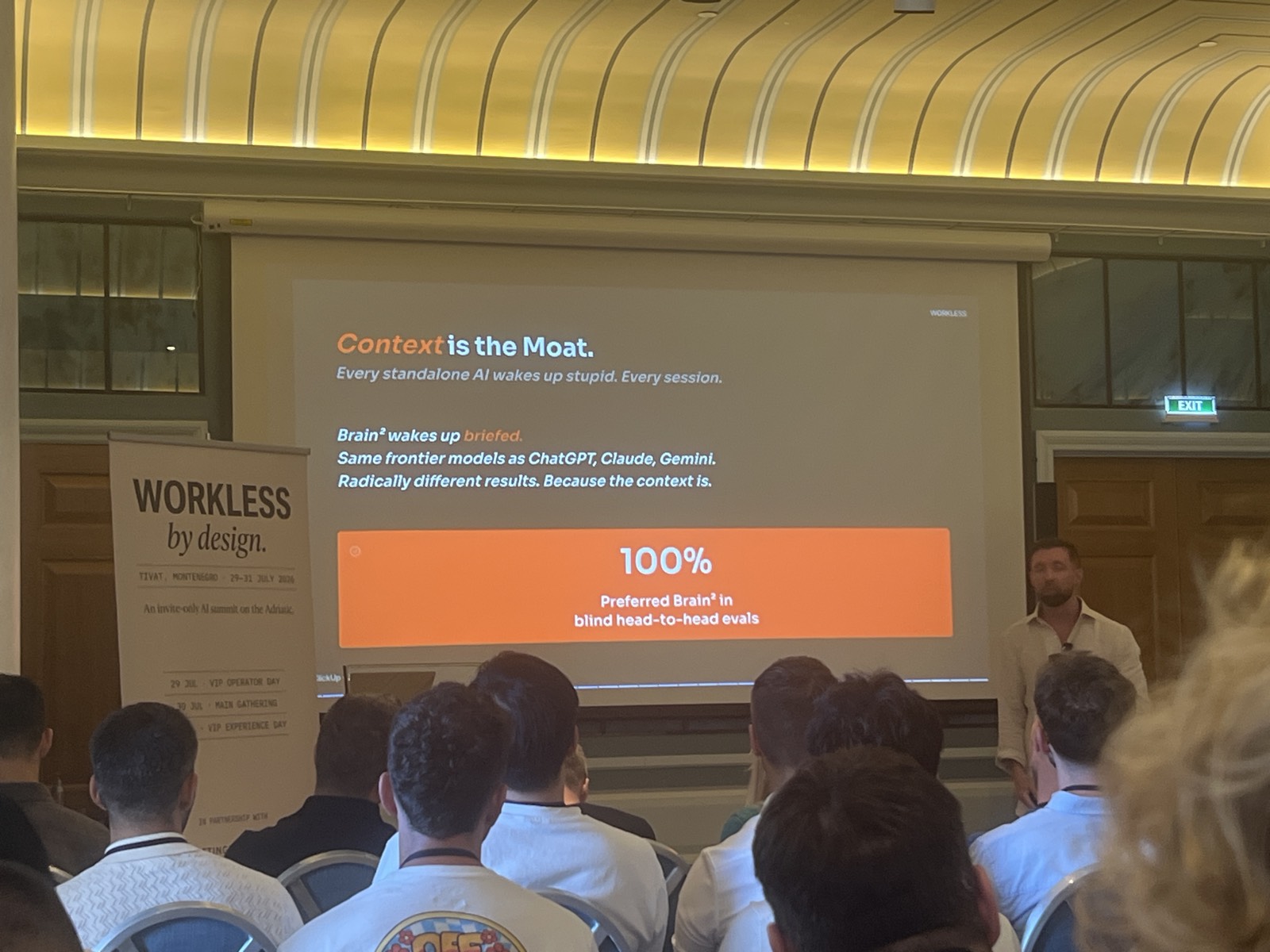
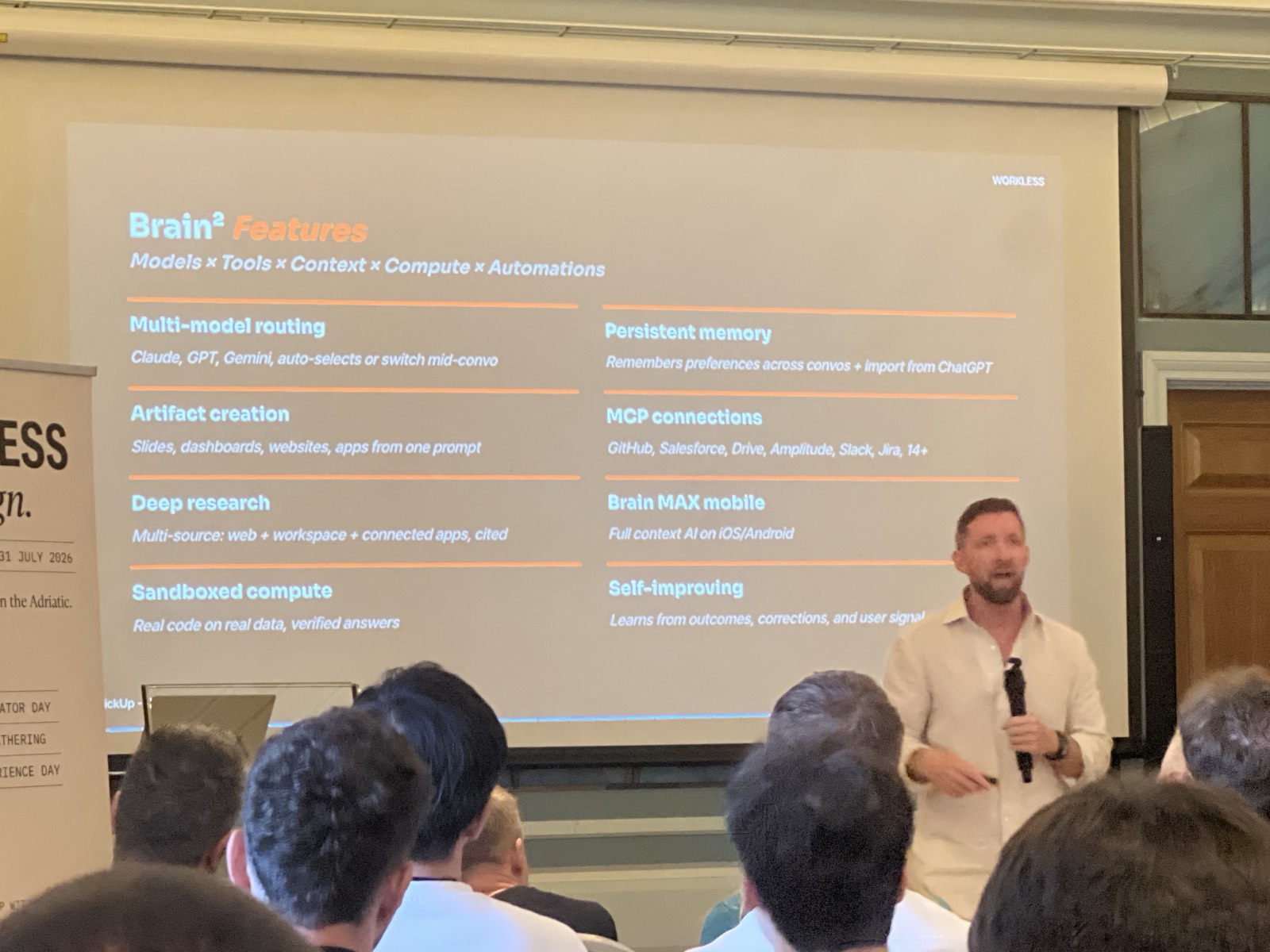
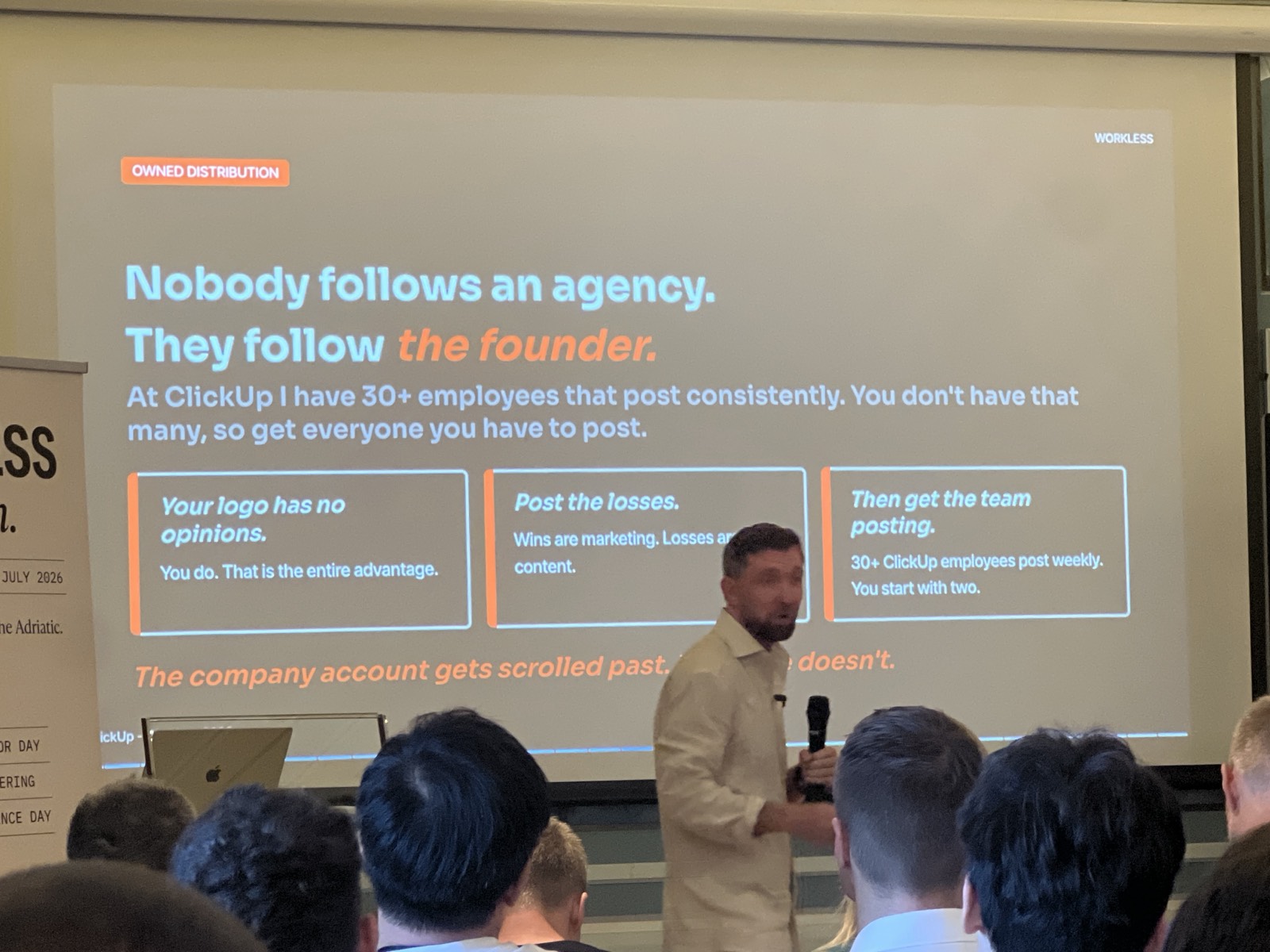
The ClickUp co-founder's growth playbook: audience beats product, scrappy acquisition, and the strategic bet that context is the moat. ClickUp is a ~$4bn company; the talk ranged from the "Jira Sucks" ad to AEO and employee-generated content.
Key takeaways
- Audience beats product: their pre-ClickUp app was better than Snapchat's clone and still died - "no matter how good your product, it means nothing if no one sees it".
- Scrappy plays: scraped competitors' 2-star reviews and contacted the unhappy customers; when a competitor shut down, built the migration tool in 3 days and onboarded ~20,000 users (UNVERIFIED).
- "Swing up": attack bigger competitors by name - incumbents will not punch down.
- AEO replaces SEO: get cited by GPT/Claude/Gemini by flooding indexed platforms via micro-creators (~10 sub-20k YouTubers + 200-300 small LinkedIn creators at $200-300/post, UNVERIFIED).
- EGC: 30+ employees posting daily; people follow people, not logos; raw phone-shot beats polished.
- Rule of three: every post must solve, make them laugh, or make them feel something - otherwise do not post.
- "Context is our focus": models are interchangeable; the company that owns the CONTEXT of work wins. Internal target of 10+ agents per employee; "we're MCP'd to everyone".
The context-moat quote is third-party proof of the AIOS thesis from a $4bn company - use it in decks and the course. Rule of three is a cheap filter for /social-post. AEO goes in the marketing-hire backlog. Chris messaged Matthew on LinkedIn the next morning - warm follow-up.
Slides captured (4)
AI workshops to company brain
Riccardo Belli Contarini Confirmed - schedule + slides
His name is printed in the deck footer - the strongest slide confirmation of the day.
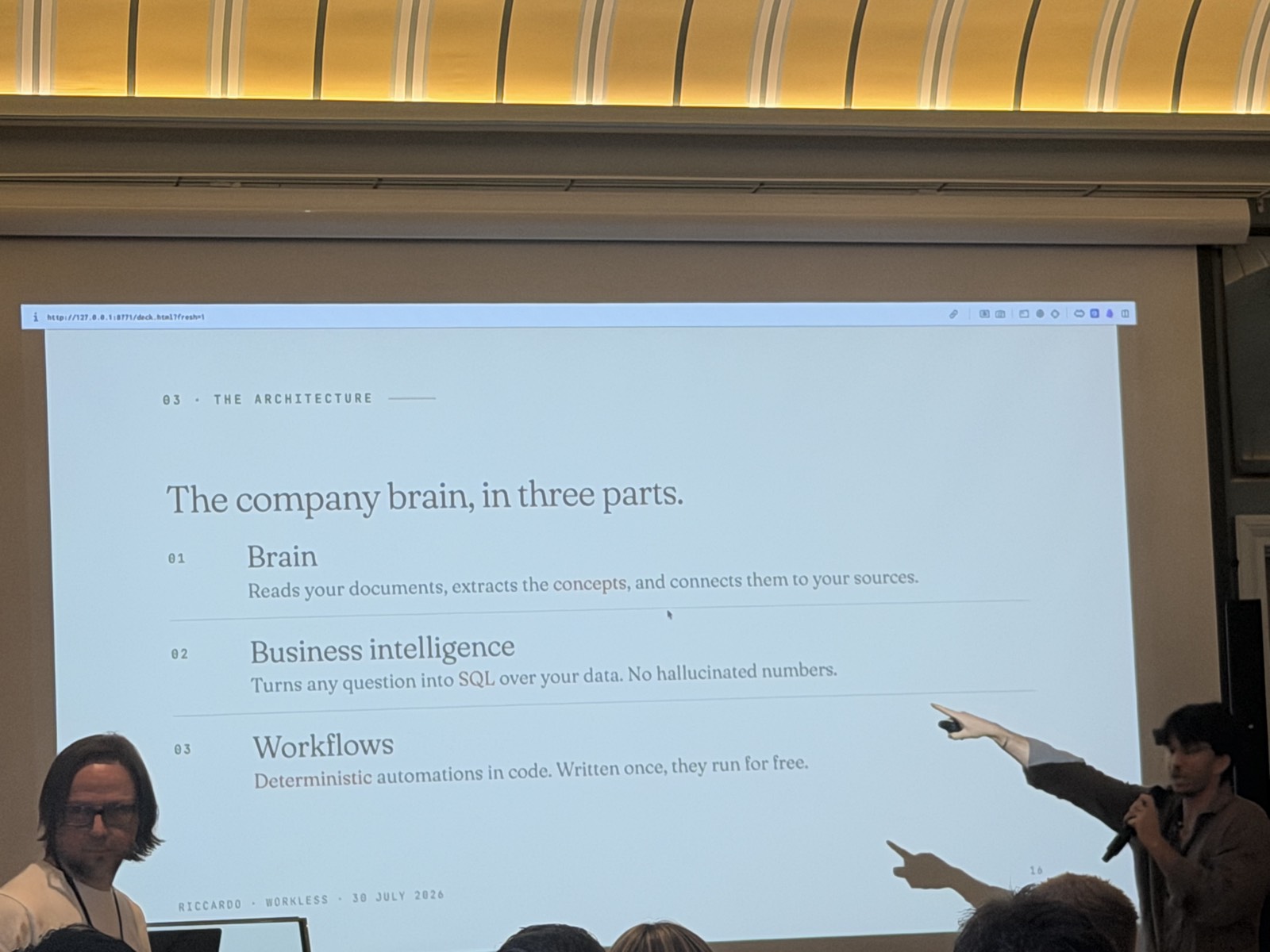
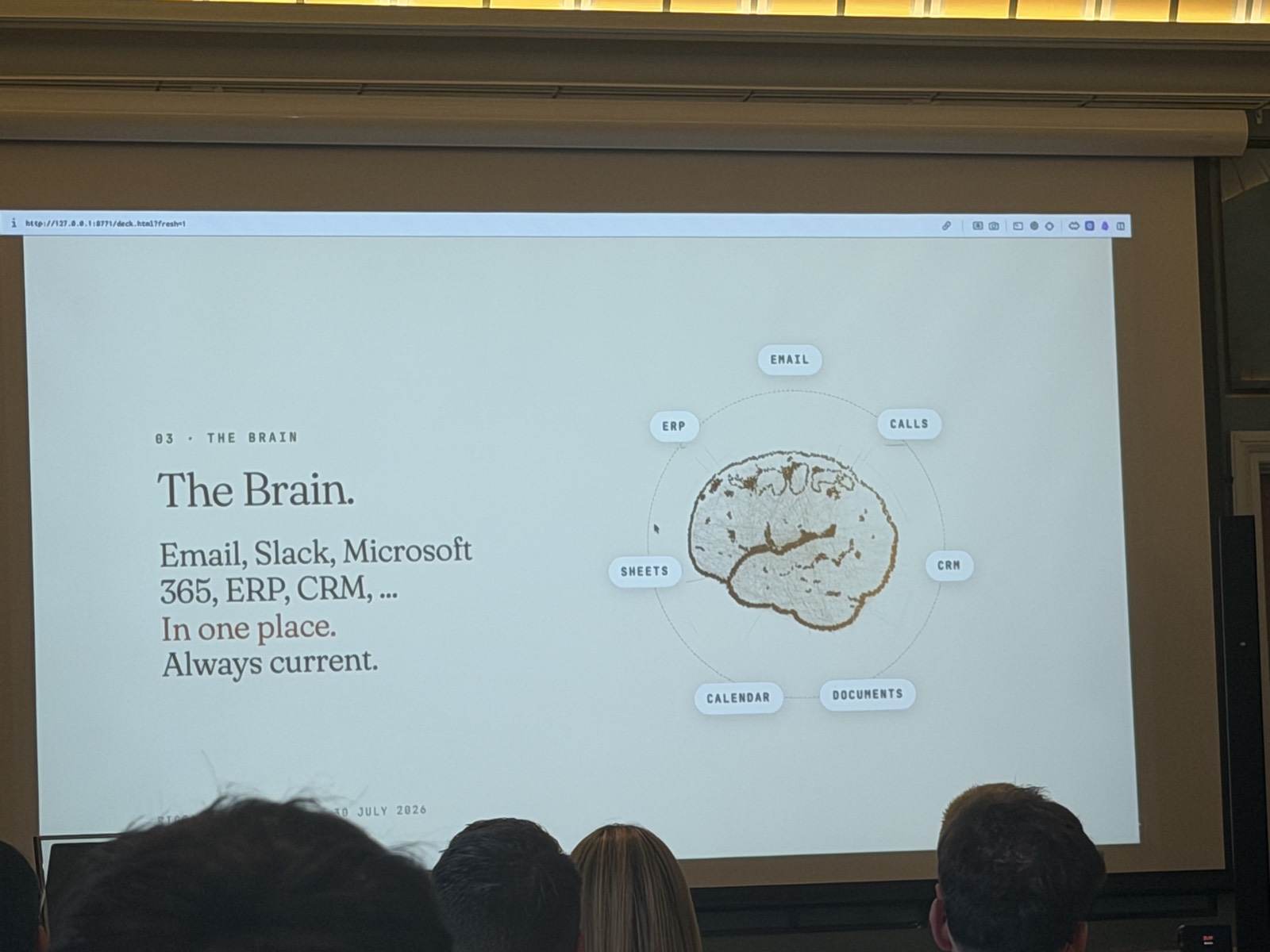
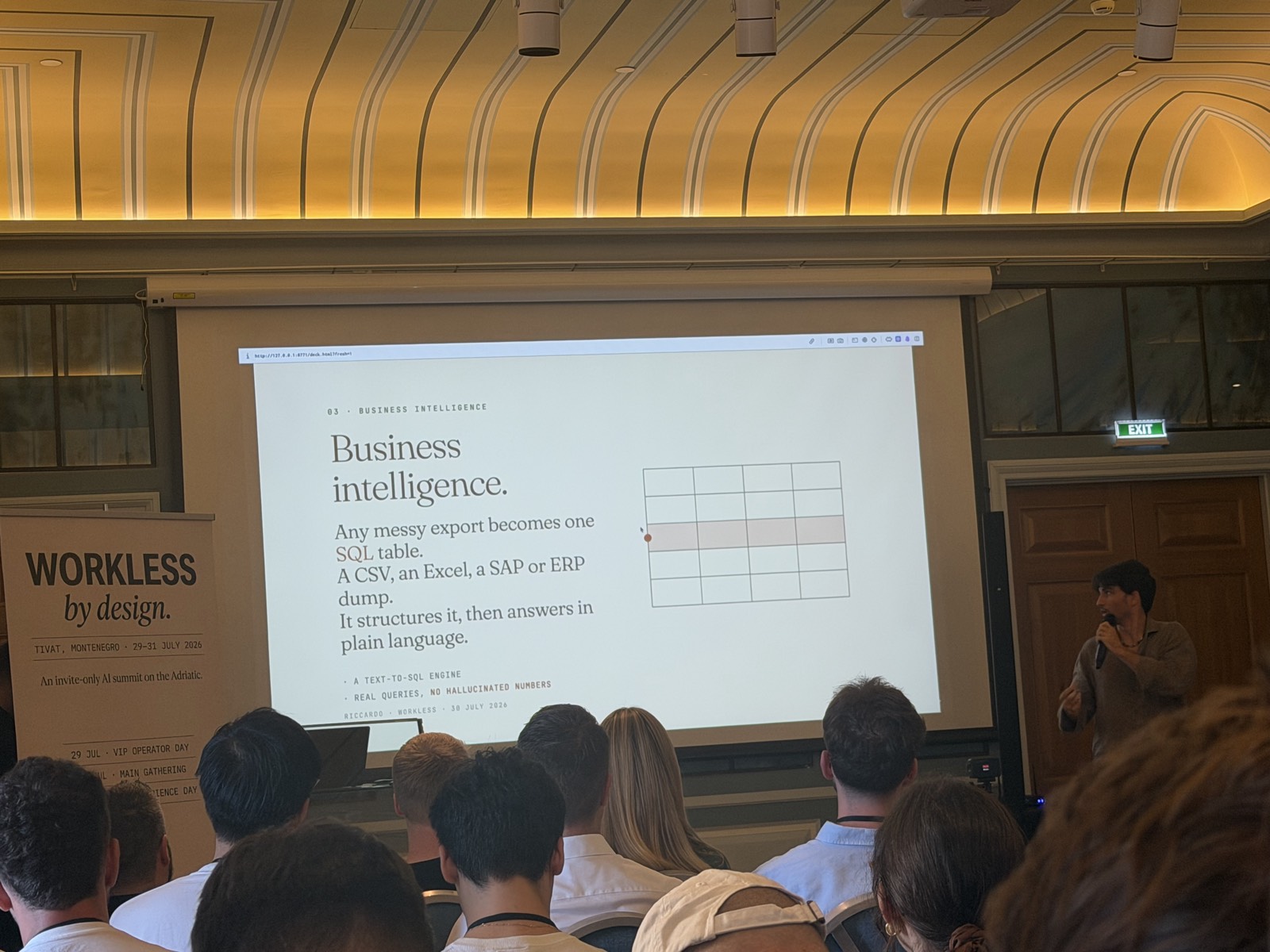
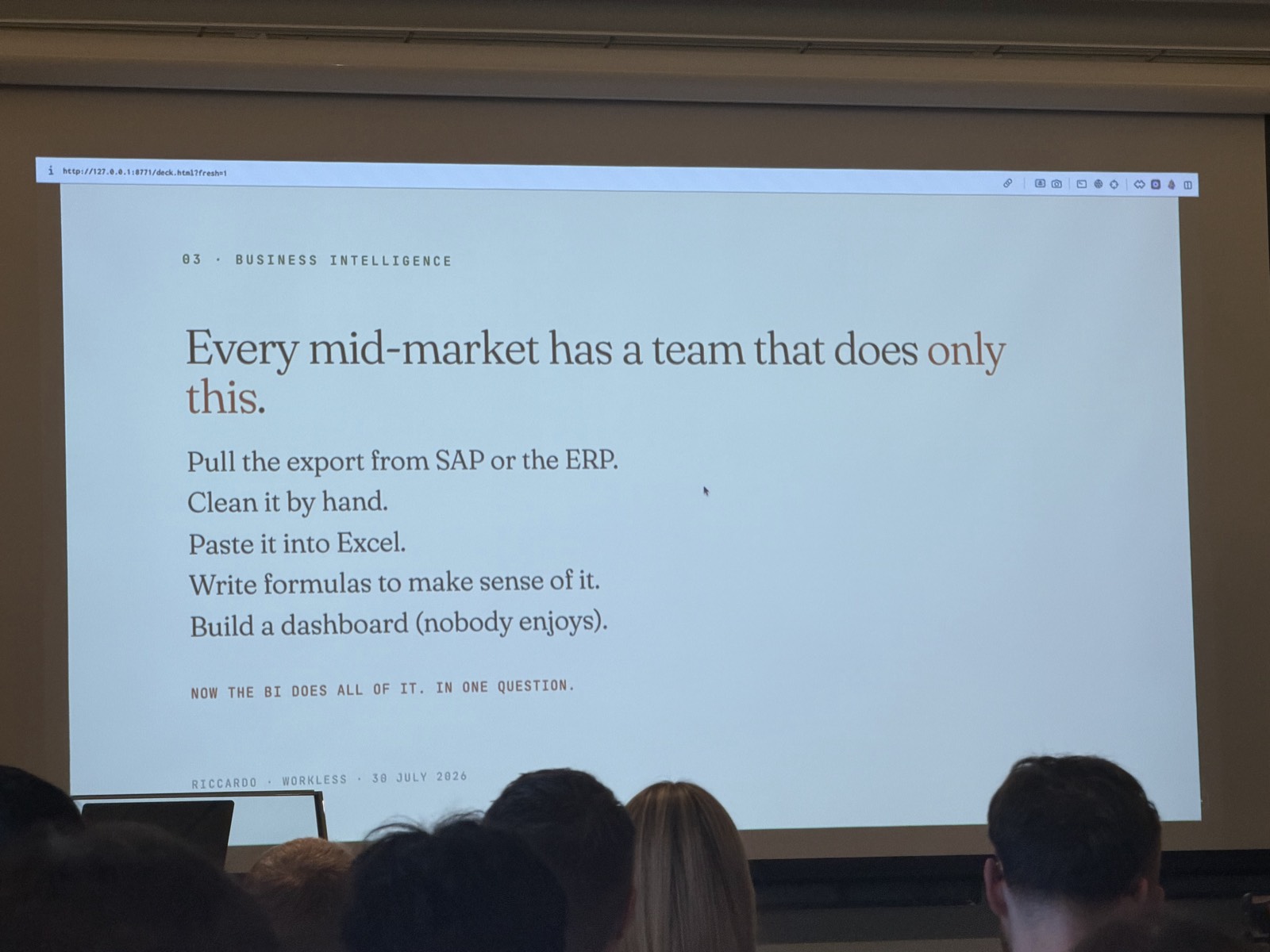
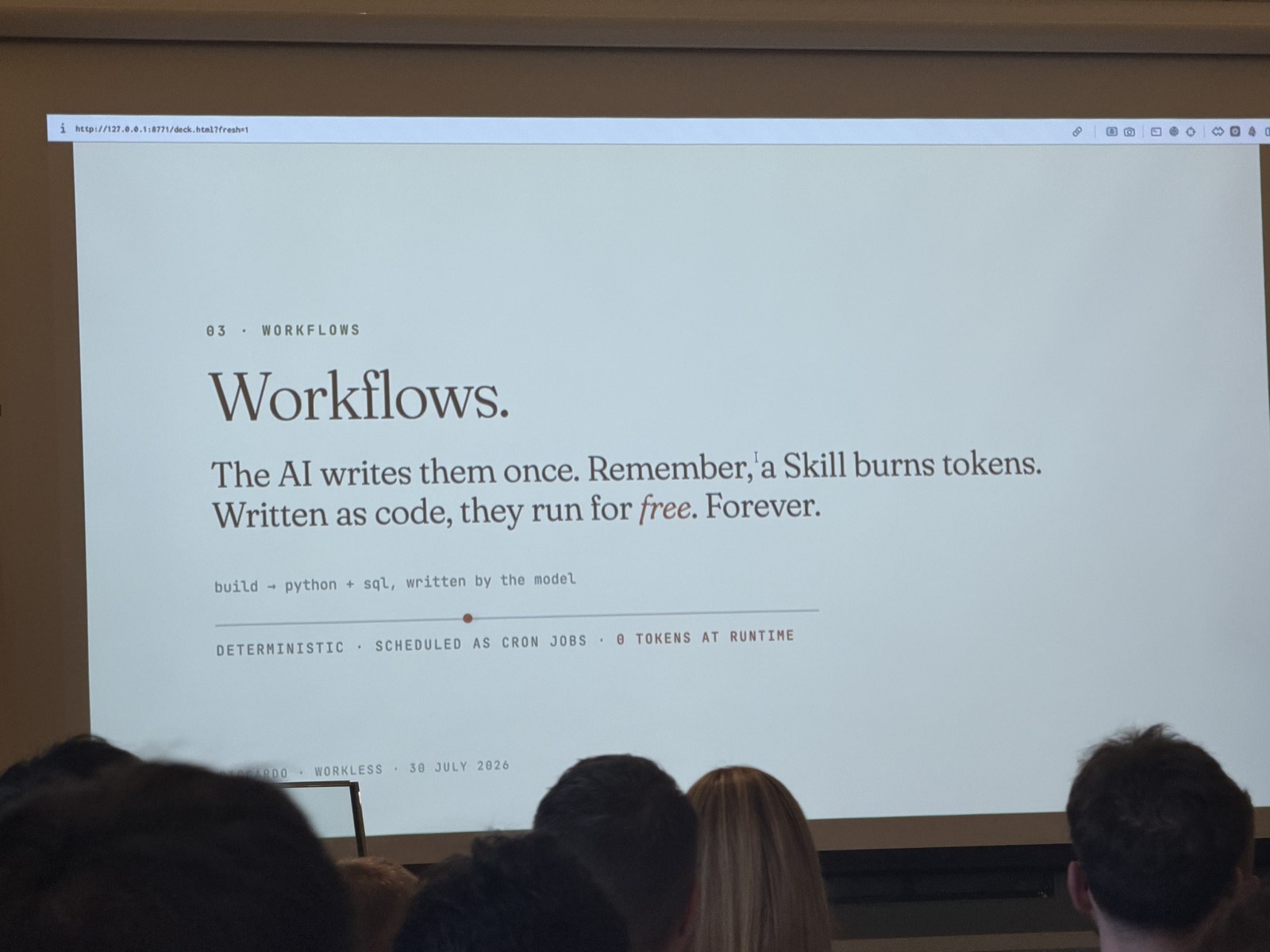
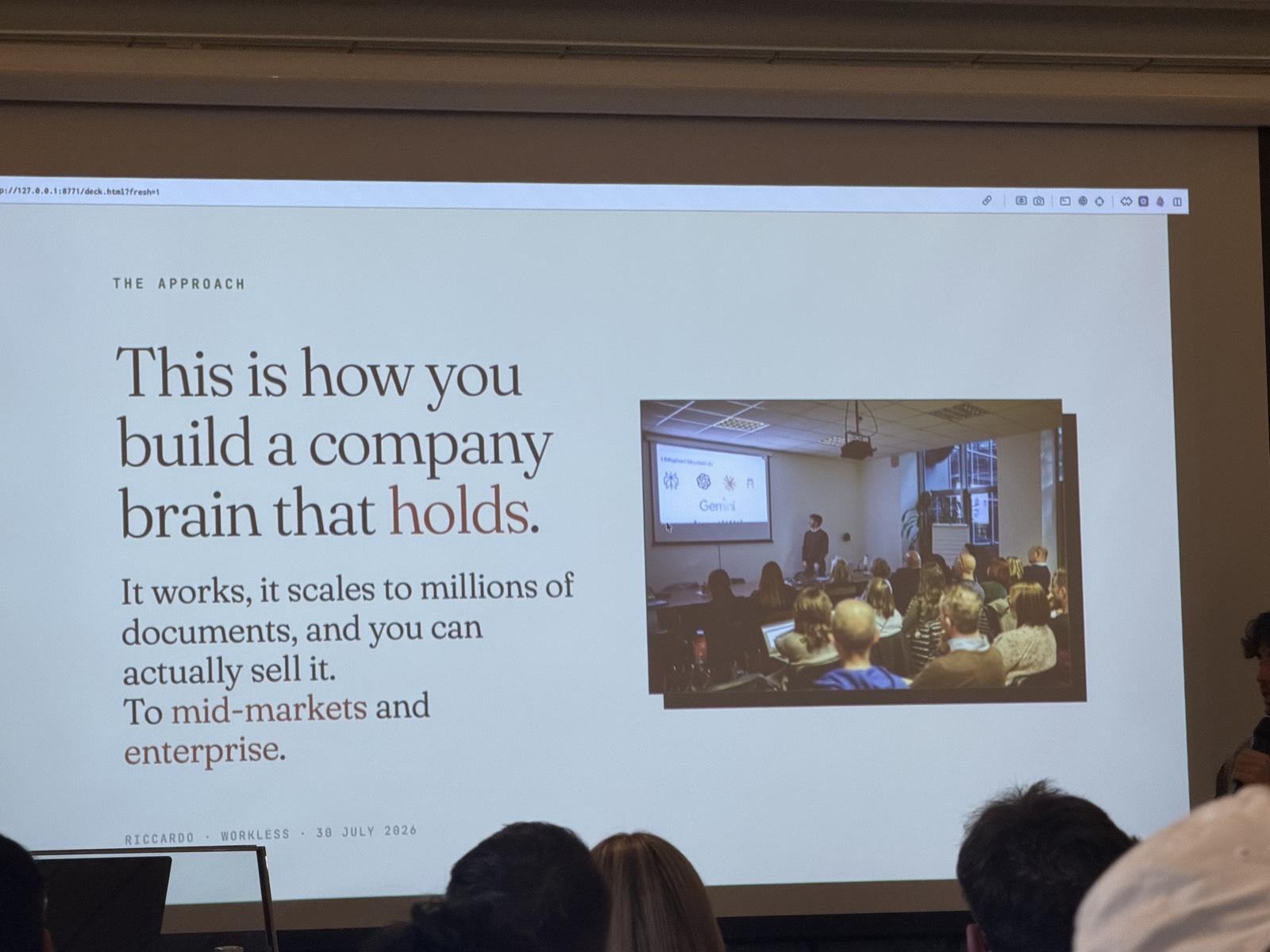
An EU founder building "company brains" for mid-market firms: why chat-first assistants break past ~30 users, and the three-part architecture that replaces them - document brain, text-to-SQL business intelligence over an enterprise ontology, and deterministic scheduled workflows that cost nothing in inference.
Key takeaways
- EU enterprise buyers reject hosted-LLM stacks on data residency before the demo; clients "bring their own LLM" and pay for the system, not tokens.
- Quality must come from the SYSTEM (ontology + SQL + deterministic routines), not the frontier model - model-agnostic by design.
- The chat-first brain degrades past ~10k documents and 40+ concurrent users (UNVERIFIED); deterministic workflows make daily tasks free at runtime.
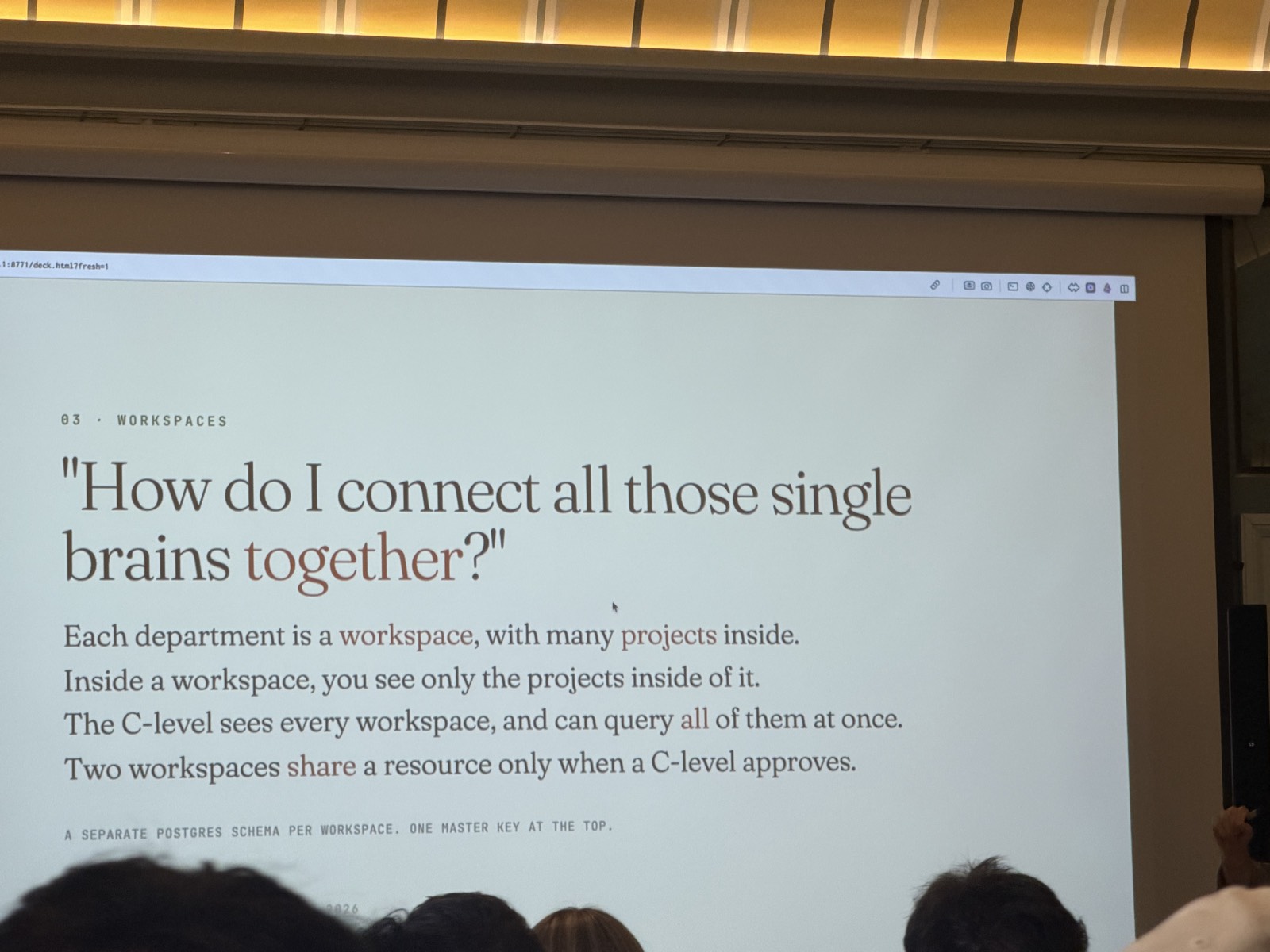
- Departments as workspaces, C-level federates across all of them - a clean permission model for multi-user installs.
- His honest ceiling: an AIOS of our shape is "great for SMBs, but when it's more than thirty people, it's not enough" - past that you need the BI/ontology layer.
Direct architecture input for Liberty: push routine adviser workflows into deterministic code and keep inference for judgement, or Copilot usage-billing eats the royalty maths. The ~30-user ceiling is honest positioning for the SMB install sweet spot.
Slides captured (7)
Making companies AI-first
Bohdan and Adam Confirmed - schedule + slides
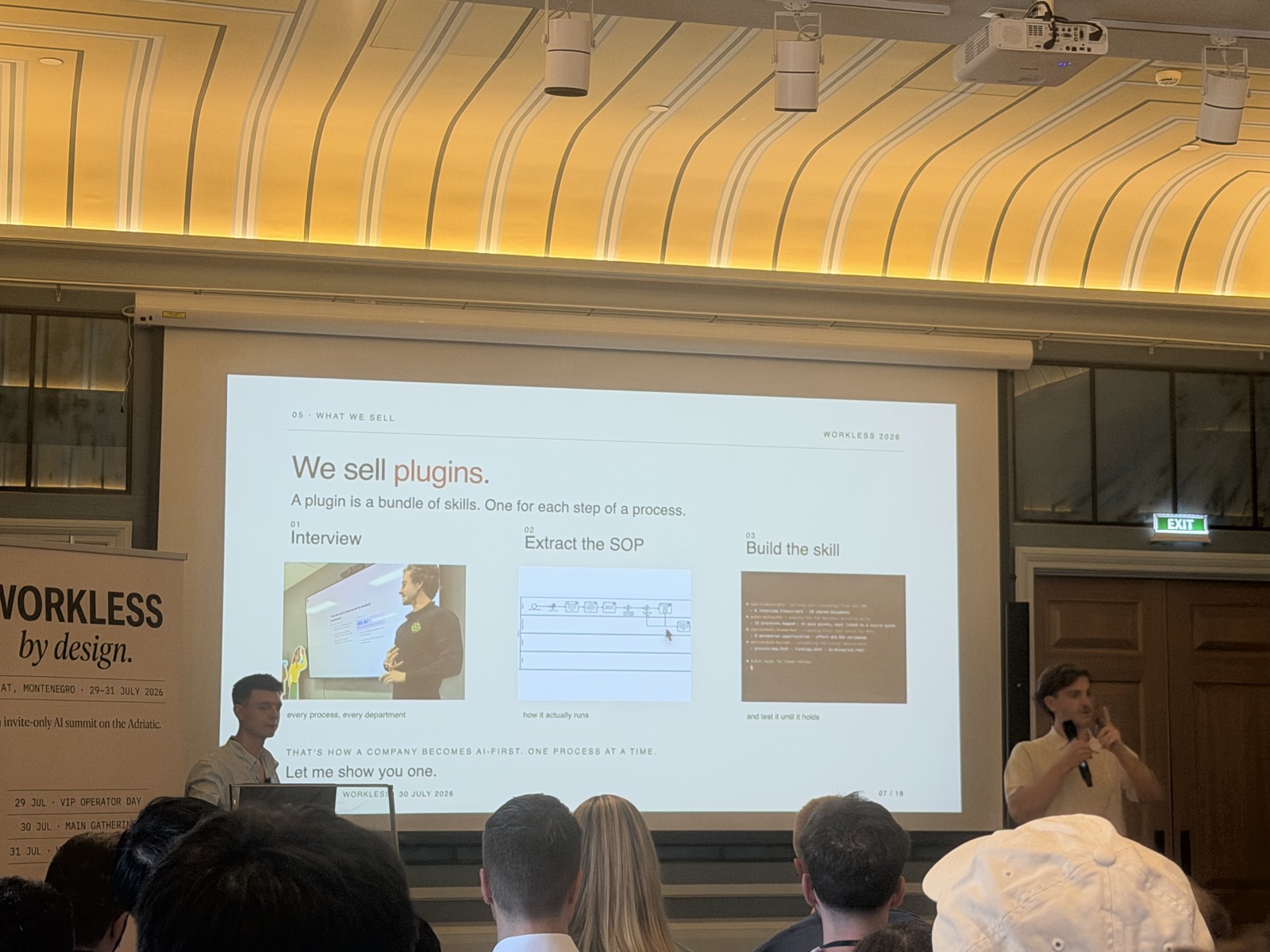
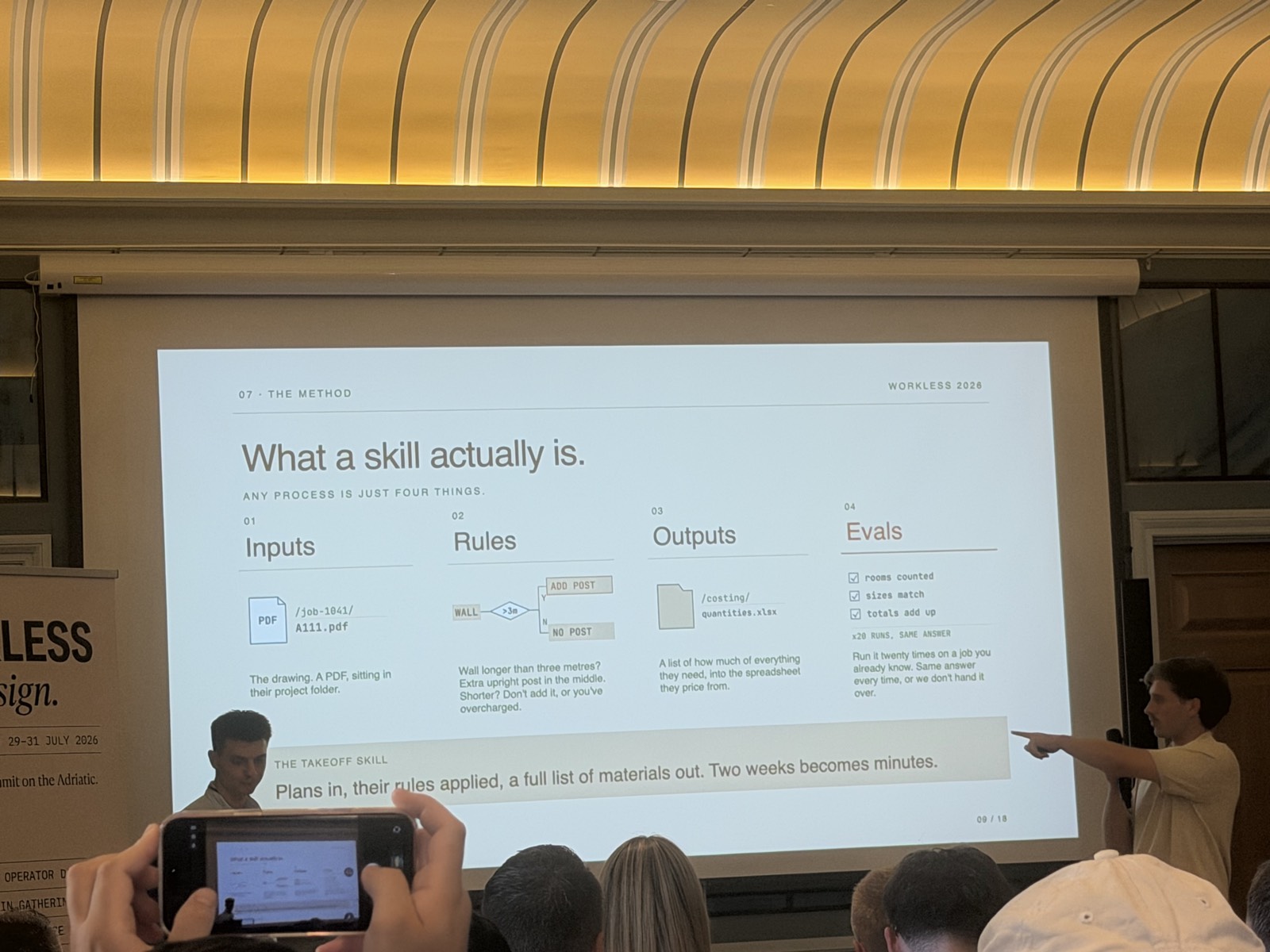
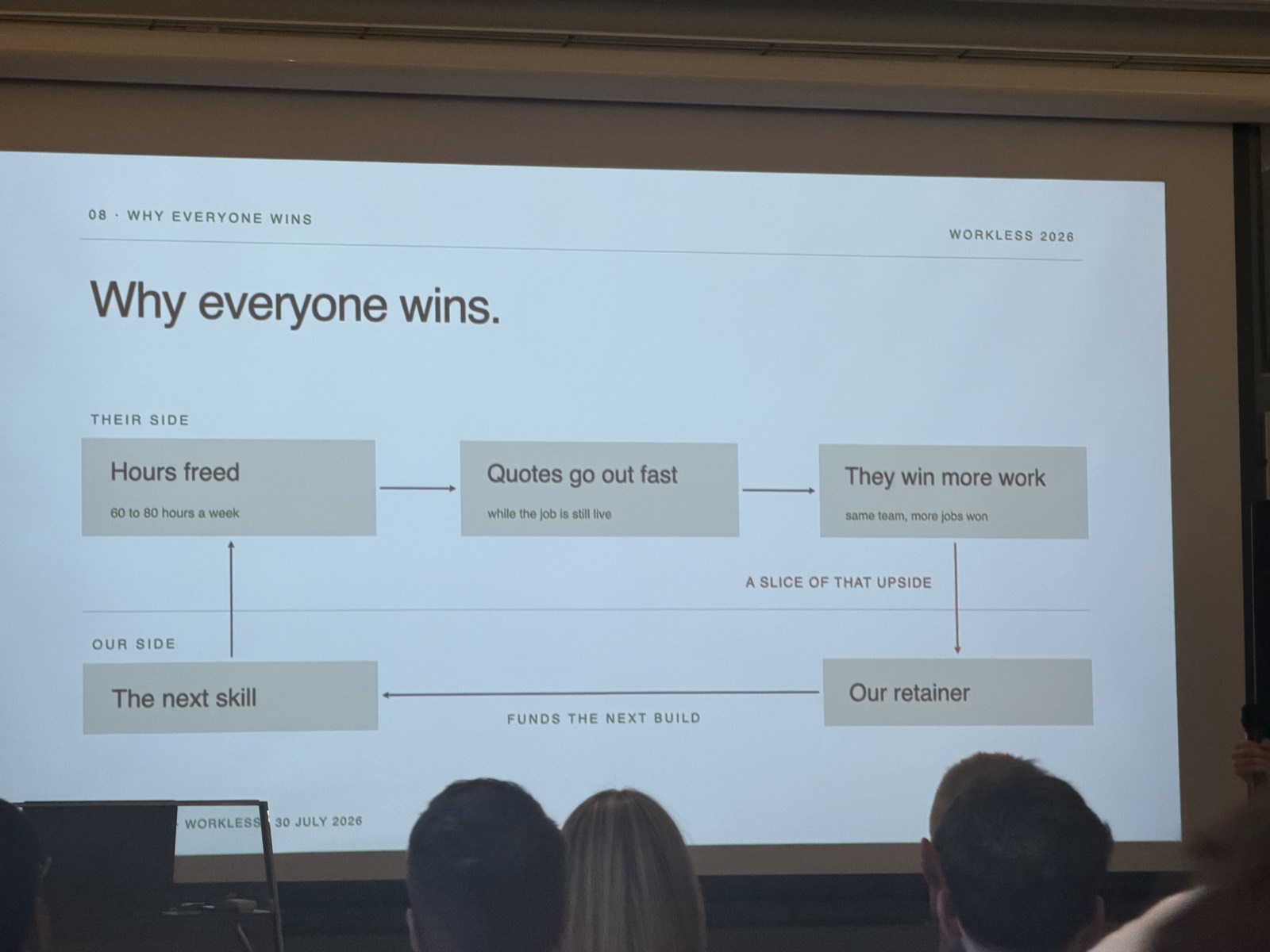
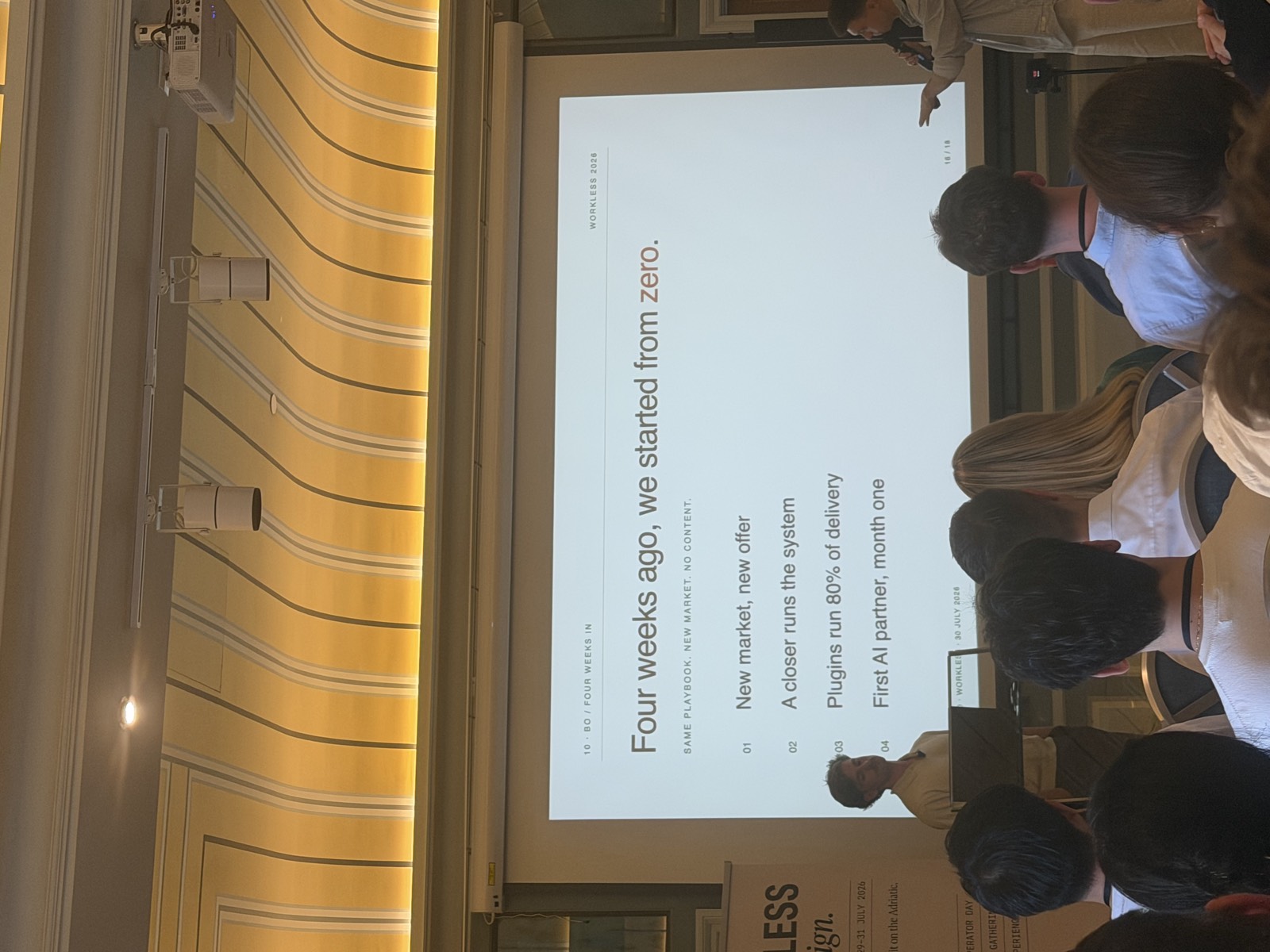
Two operators who productised agency delivery into installable skill bundles ("plugins"): process capture beats engineering, a skill is inputs + rules + tests, and the retainer is a slice of the measured saving.
Key takeaways
- A plugin is a bundle of skills mapped to a departmental workflow; one 2-hour boardroom session with domain experts can automate up to 80% of a 10-20 hour process (their claim, UNVERIFIED).
- A skill is inputs, rules, tests - validated with 20-50 isolated trials before it is trusted; a misquote can cost hundreds of thousands.
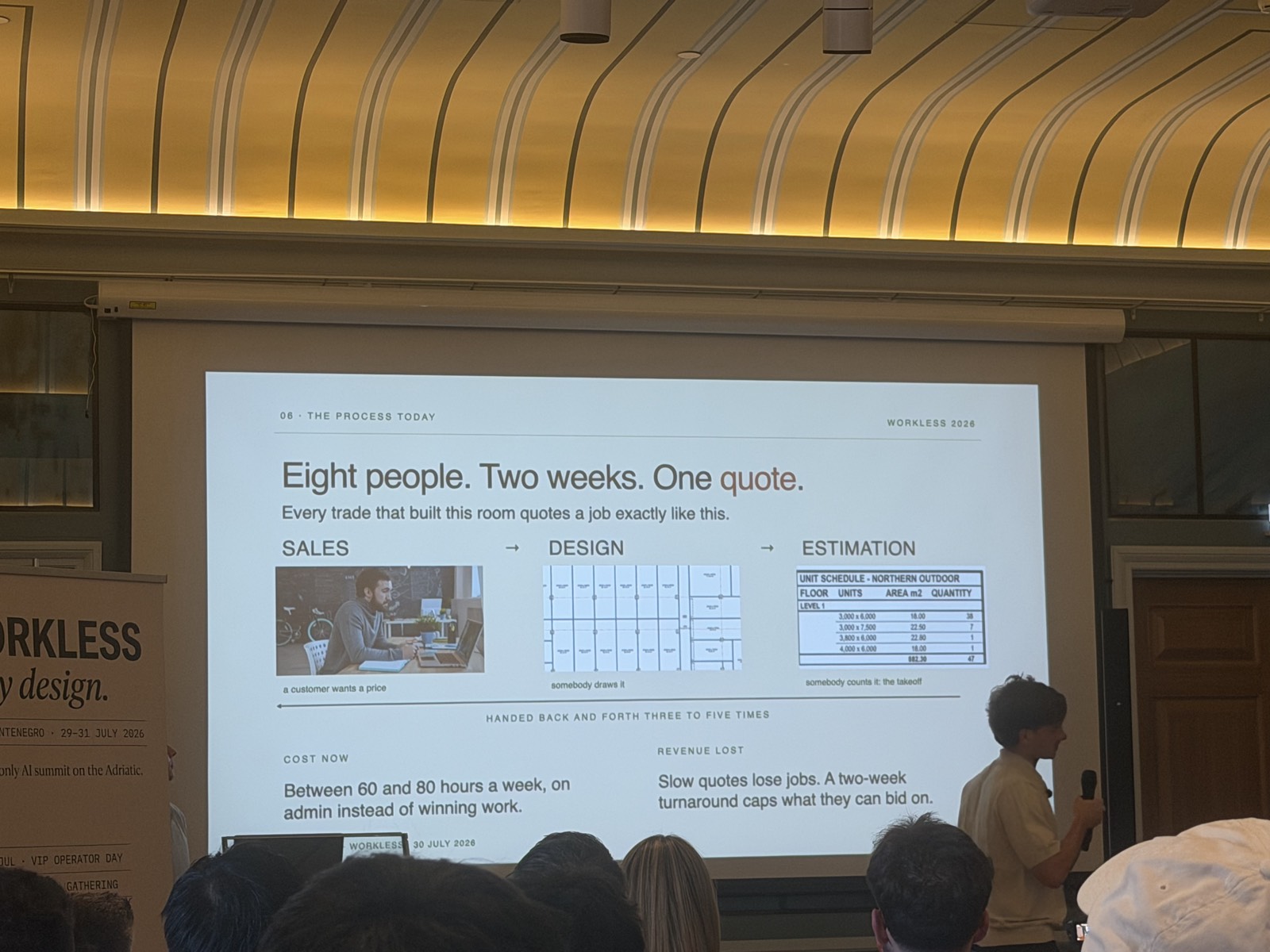
- Worked example: construction estimation cut from ~2 weeks touching 8 people to same-day - faster quotes mean more won work, not just saved hours.
- Deterministic ROI sale: audit first to baseline hours/touches/cycle time, then "give me $1 now and get $2 back in two weeks".
- Traffic / System / Skill: every service business is bottlenecked by exactly ONE of lead gen, conversion or delivery at a time - diagnose the binding constraint and work only on it.
Steal the ROI-slicing retainer language for the Blueprint and proposals, and the 20-50-trial validation bar for regulated-client skills (Liberty adviser skills especially). The constraint framework is worth ten minutes with Michael.
Slides captured (5)
What Big Companies Buy, and How to Build It
Ethan Monkhouse Confirmed - schedule + slides
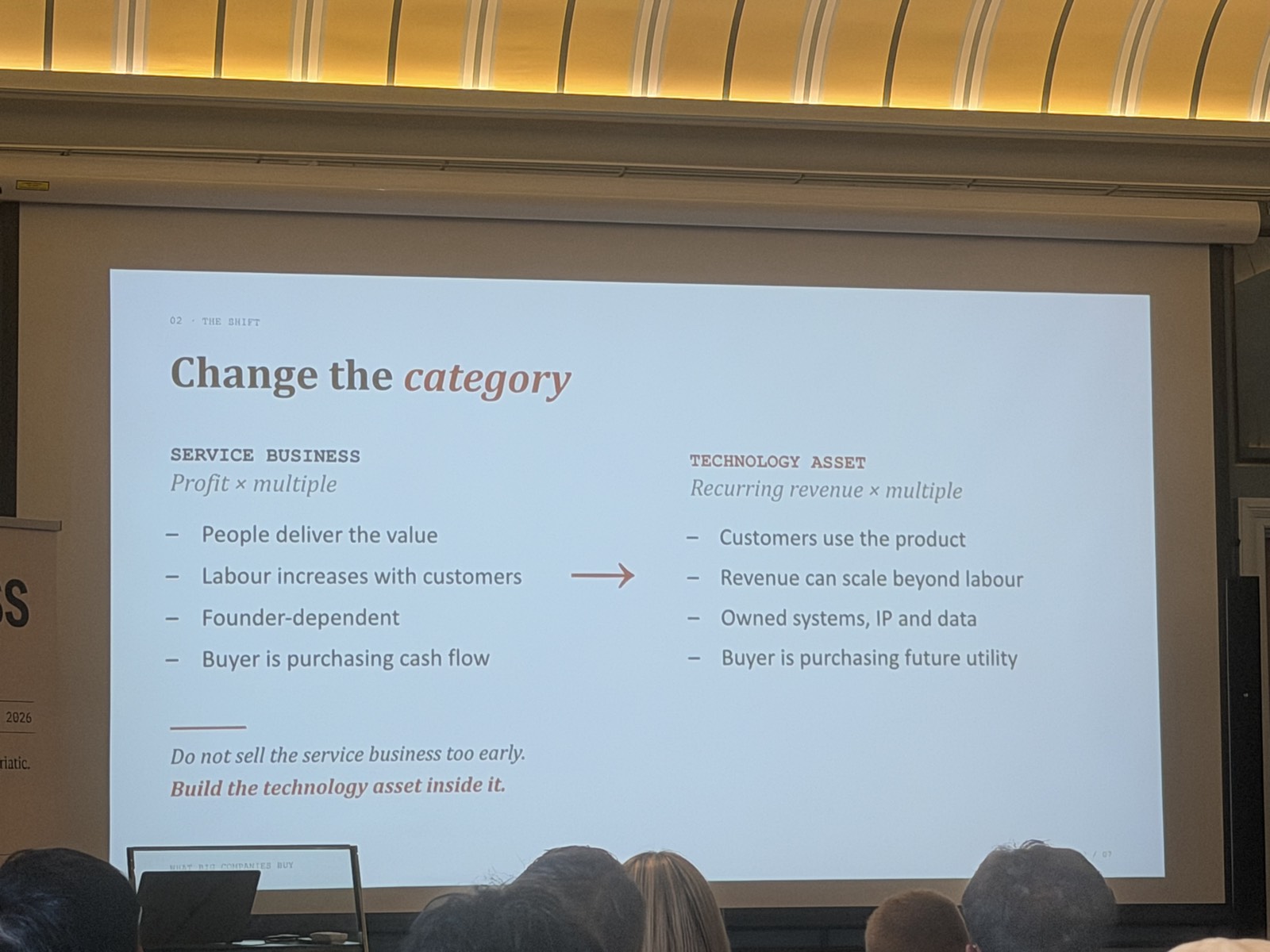
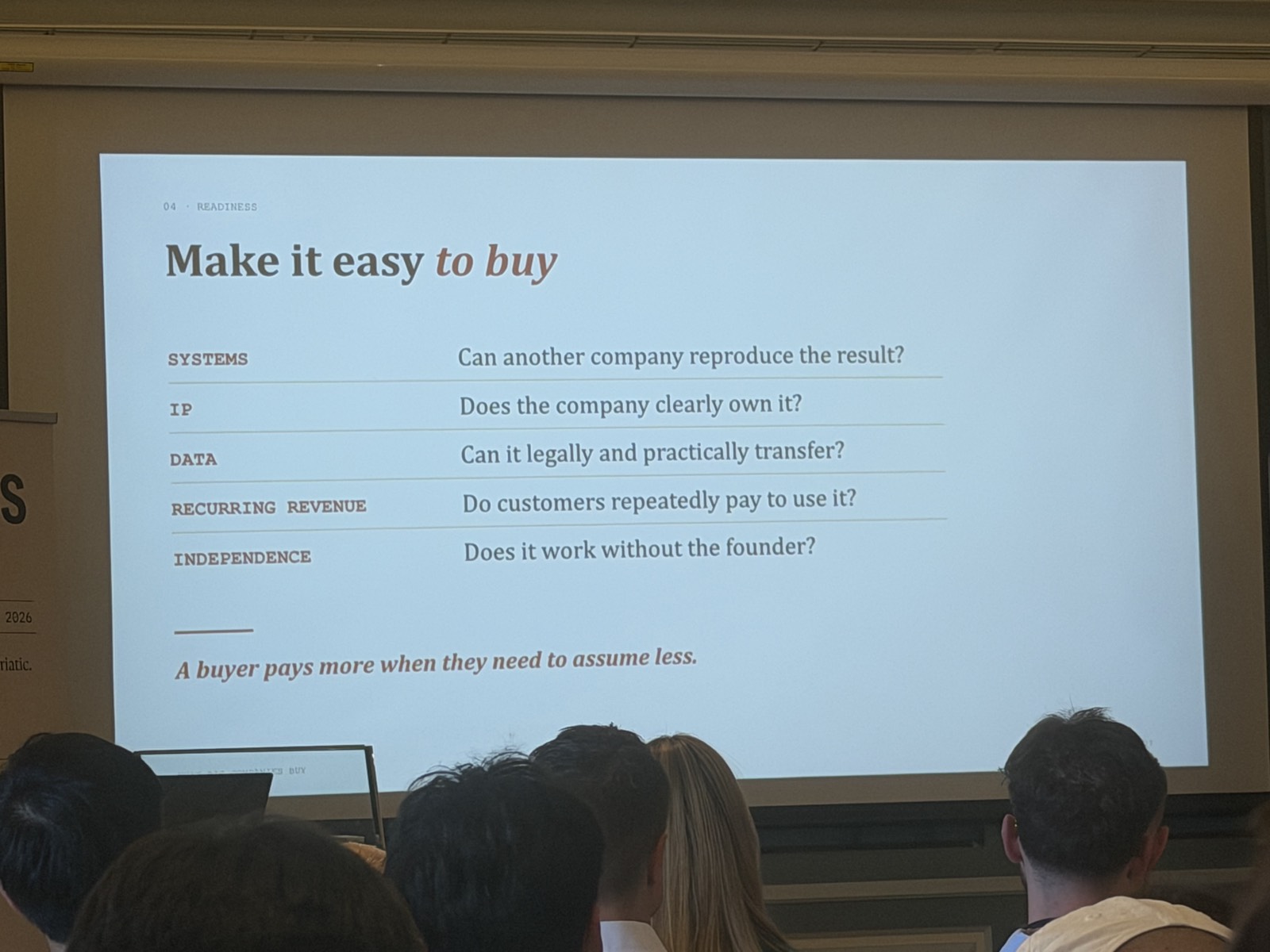
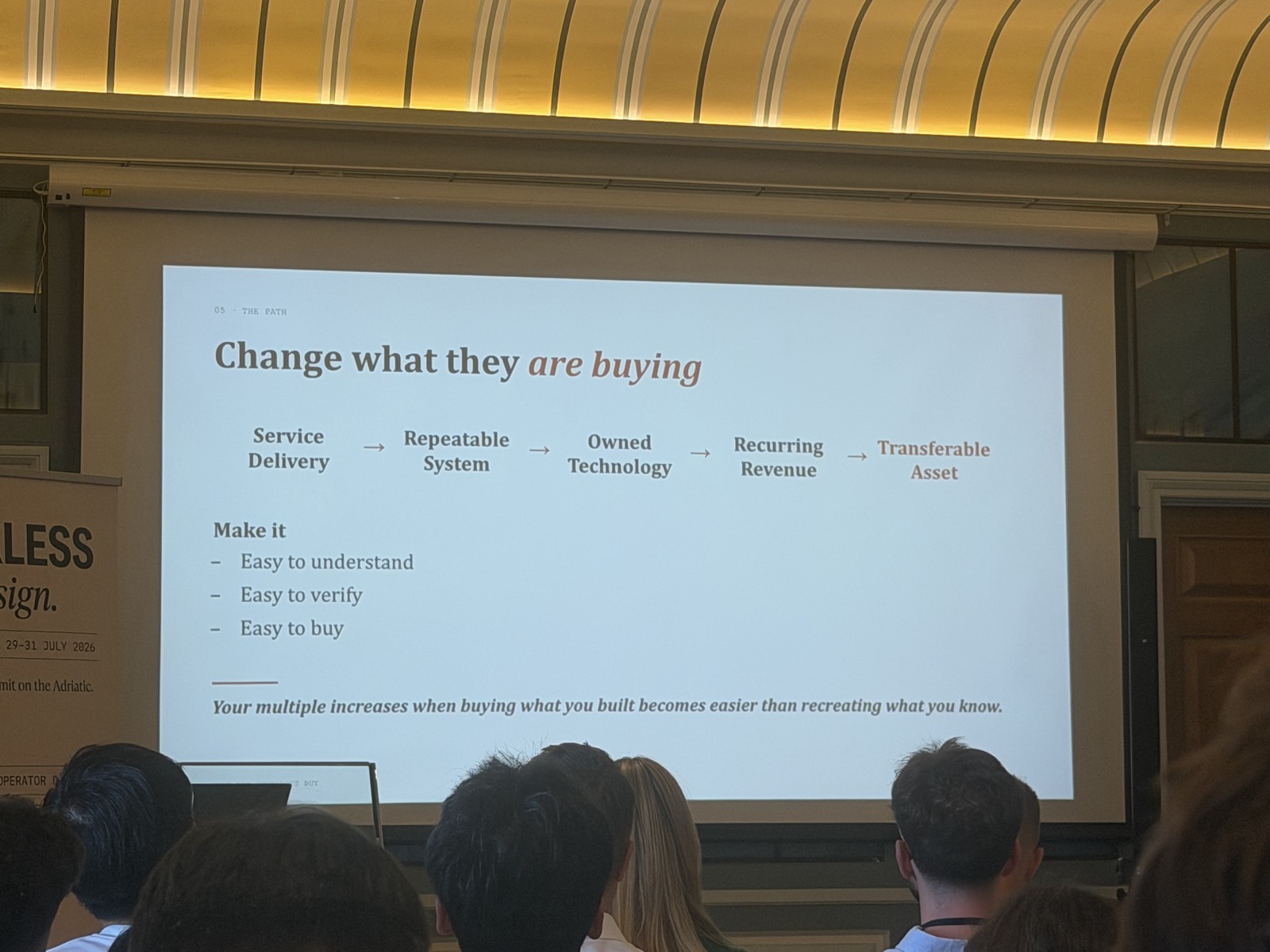
Why service businesses exit at roughly 2.7-3x annual profit, and how to break the ceiling: change the asset class, not the multiple. Package accumulated data and intelligence into a proprietary technology asset that is transferable and defensible.
Key takeaways
- Grounding exercise: average monthly profit x 36 - that is the ceiling while buyers are valuing cash flow tied to human delivery.
- The escape: package intelligence into a technology asset that is TRANSFERABLE (documented, a new owner can run it) and DEFENSIBLE (hard to recreate).
- "The multiple increases when buying what you build becomes easier than recreating what you know."
- Service firms beat pure software plays to product-market fit via warm client intros.
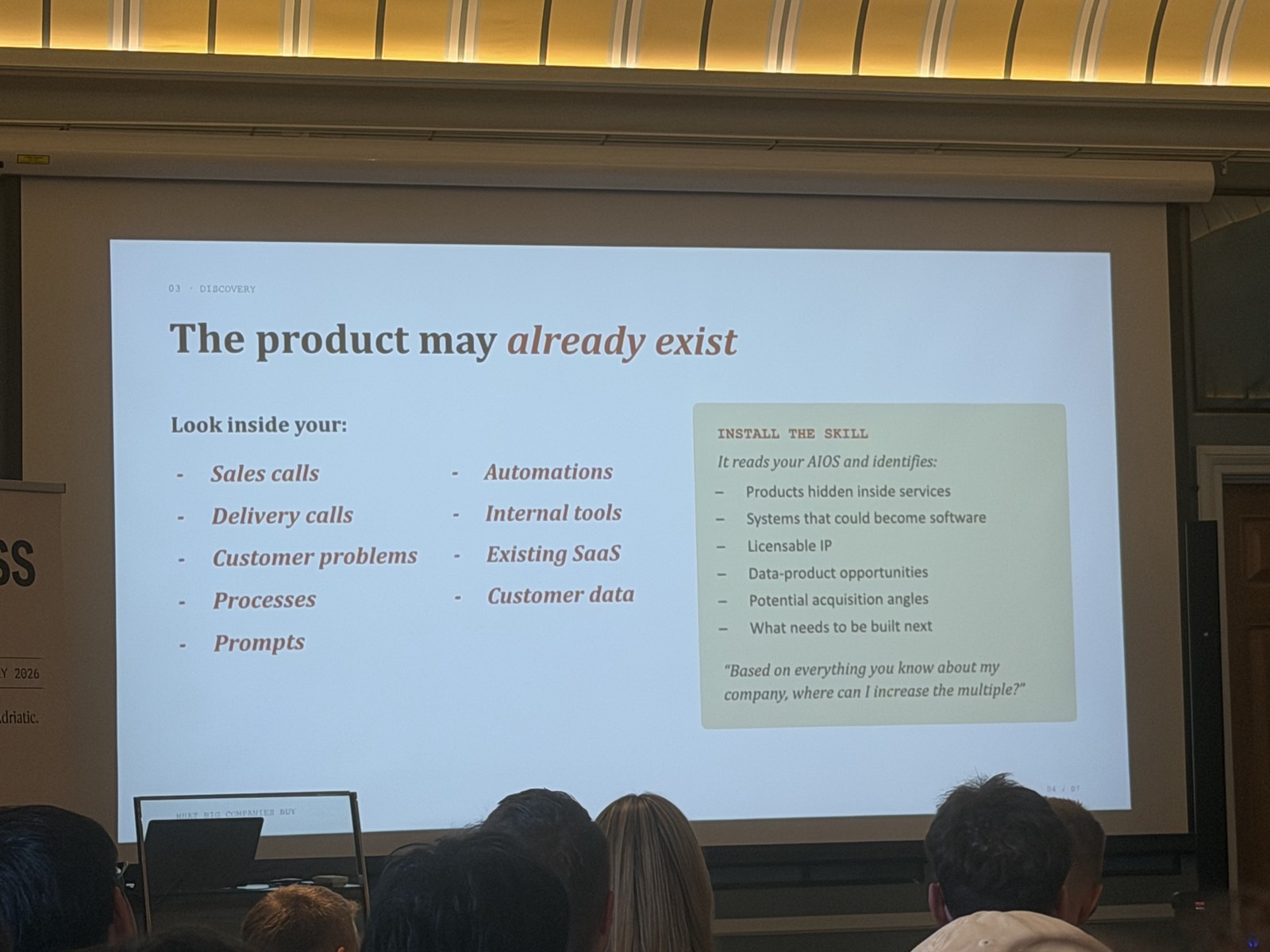
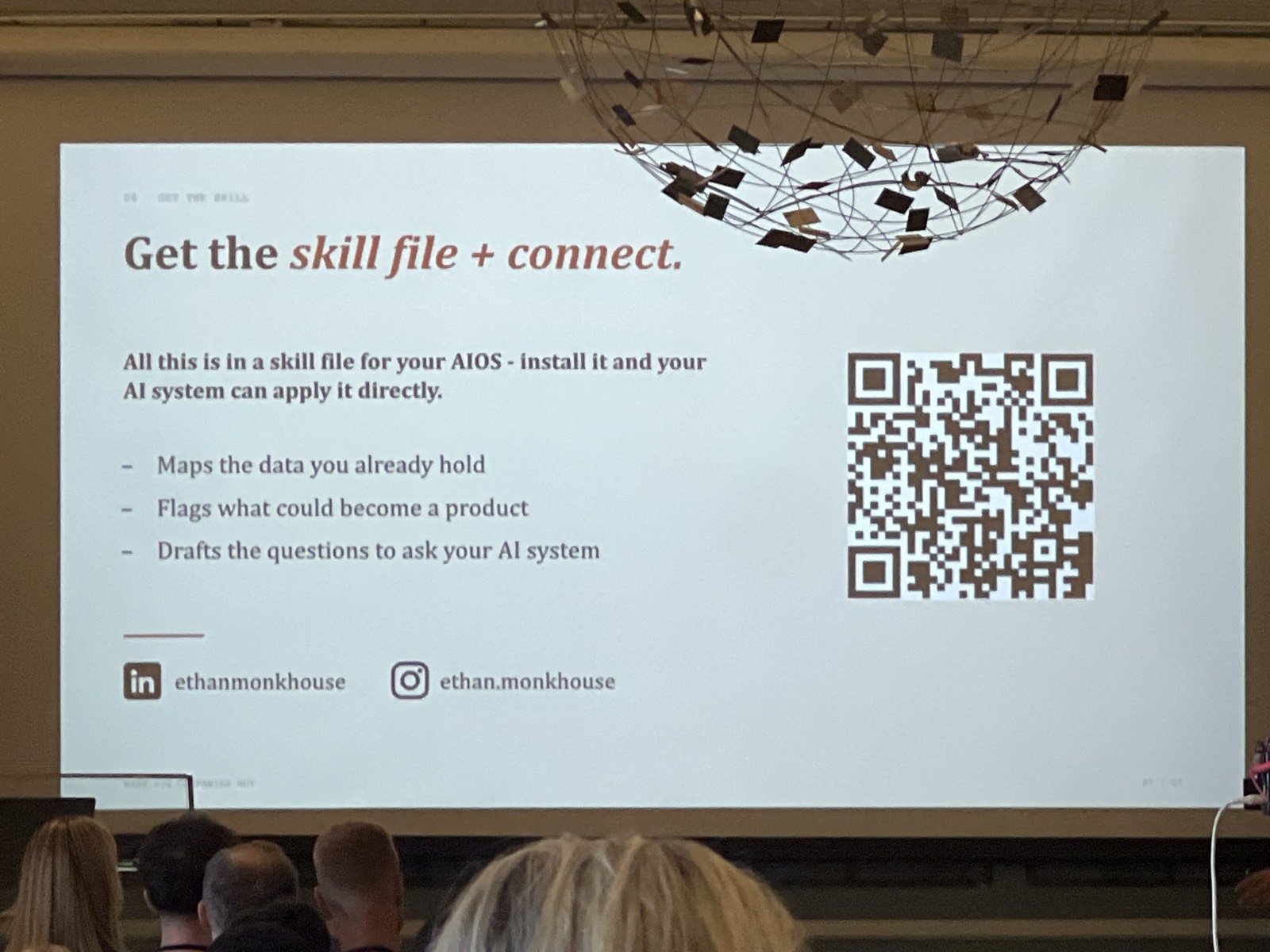
- His handout is a complete Claude skill (exit-opportunities) that reads an AIOS and finds licensable IP - in the KB resources folder.
Near-verbatim confirmation of the skills-as-IP exit thesis. Fold the transferable/defensible framing into the Liberty term-sheet thinking: the pilot's data and machine-learned intelligence must be priced, not given.
Slides captured (5)
AI won't replace you, it will expand you
Akil Wade Confirmed - schedule + slides
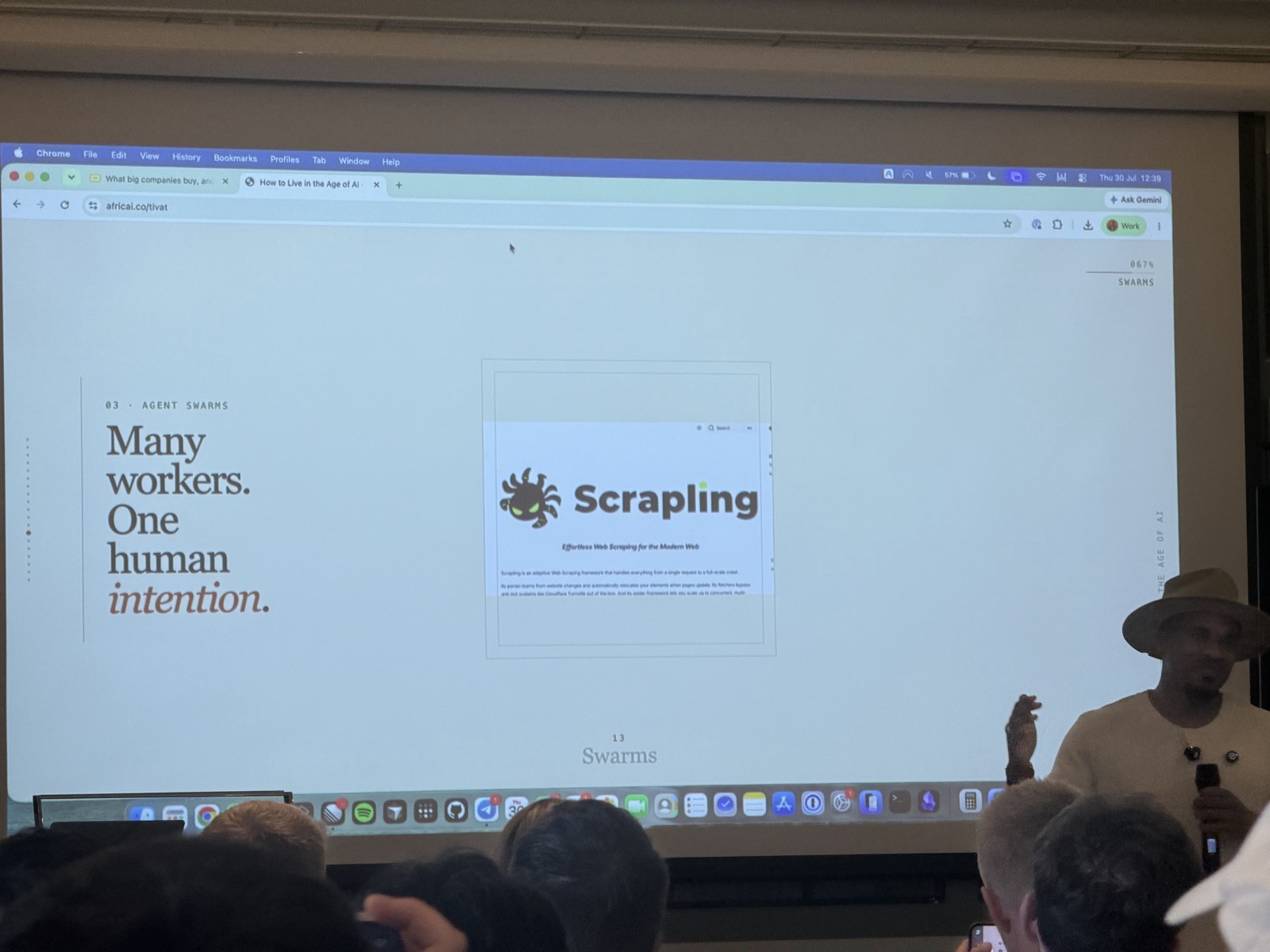
Akil is the AfricAI organiser Matthew knows from Cape Town; his slide shows the deck live at africai.co/tivat.
A closing morning session on authentic AI-driven content at scale: a content factory trained on his own scripts, a sponsor-recovery play built on showing brands their finished sponsorship before they pay, and a daily one-document "sweep".
Key takeaways
- Content factory: an agent trained on all his past scripts drafts in his cadence, a director agent assembles a ~90% complete edit; claims 5.6M views in 30 days without appearing on camera (UNVERIFIED).
- Sponsor-recovery: sent hundreds of personalised AI videos - his face plus each target brand's logo - showing sponsors what THEIR sponsorship would look like. "Show them the end result before they pay."
- His "sweep": one daily document consolidating all inboxes, tasks and money - read before the day starts; three must-do items, everything else is noise.
- Core thesis: with everyone on the same models, authenticity is the only durable differentiator - AI distributes your original thoughts, never generates them.
- Do NOT copy: the agent-swarm mass-DM attendee-fill tactics - they violate the workspace no-bot-outbound rule and deliverability discipline.
The sweep is the AIOS morning brief - independent proof the daily brief is the killer everyday use case. The show-the-finished-thing play validates leaning harder on /site-revamp and /demo-video recon demos.
Slides captured (1)
How Hostinger runs without Hostinger in the room
Hostinger team Confirmed - schedule
A Hostinger PM's walkthrough of their internal AI stack: Dex, a Slack-native company agent with context, memory and per-employee dashboards, and Lumos, plain-English text-to-SQL - plus the two things that failed. No slides captured.
Key takeaways
- Dex use cases: daily scrape of ~70-80 competitors posted as per-product Slack summaries; screen-record a bug and Dex files the Jira ticket and drafts the PR fix for human approval; ~80% of influencer research automated.
- ~500 staff (50%+) now have a personal AI agent (UNVERIFIED); the 2025 goal of 50 n8n-capable employees was beaten at ~100.
- What FAILED: unreviewed AI output shipped to customers caused complaints (now human-reviewed), and automated KPI-setting was reverted because it removed judgement.
- Education-first rollout: workshops, learning hubs, a per-team AI champion.
A 1,000-person company independently converging on the AIOS shape - first-class sales ammo. Their two failures ARE the human-in-the-loop pitch: "not our opinion, Hostinger's scar tissue." The competitor-sweep pattern fits the adviser vertical as an installable skill.
Building Glaido in public
Dave, Jannis, Jack and Nate (Glaido) Confirmed - schedule
Plaud misheard the product as "Lighto". The recording spans the next slot too - Jack Roberts' 14:45 talk "The AI automation playbook for agencies" is likely blended into its tail rather than separately captured.
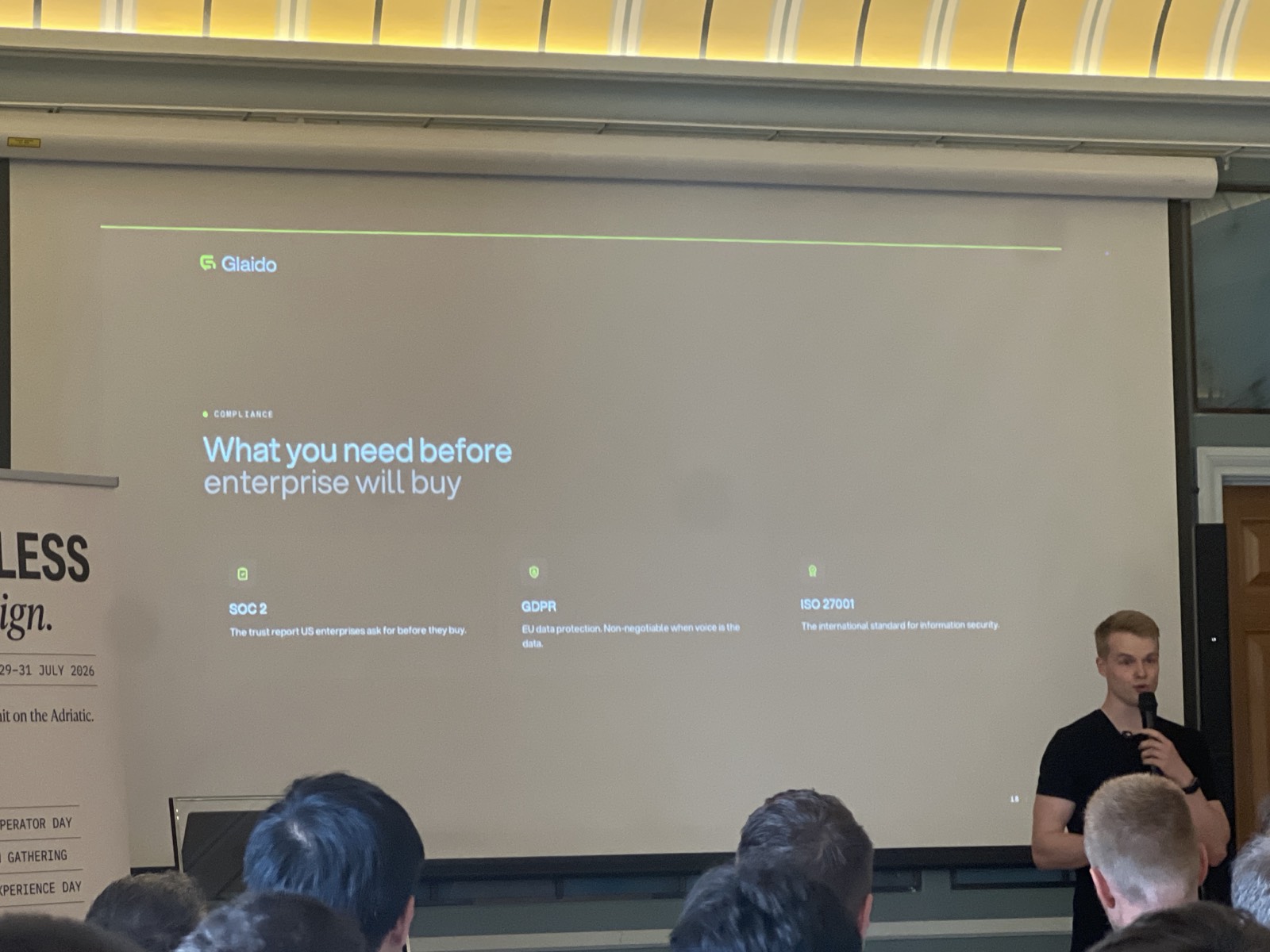
The team behind Glaido, a faster, private, EU-hosted dictation tool (a Wispr Flow competitor and conference sponsor), on product-building lessons: component-level design systems, agentic SDLC, feature-creep discipline, waitlist pre-validation and compliance as a moat.
Key takeaways
- Design systems past brand guidelines to component-level definitions (button states, hover) so AI tools build pixel-perfect UI - "do it once even for internal products".
- Waitlist as the demand test: "if I can't get 300 people to say they want this, how am I going to sell it?"
- Feature-creep discipline: experimented with ~20 features, shipped almost none - "we first really need to do one thing right".
- Compliance as moat (German co-founder): understand compliance deeply enough to AUTOMATE it, so you can sell into enterprises without adding headcount.
- Product: data processed not stored, on-device layer in development, one-click Wispr Flow dictionary import - switching is cheap.
Worth a trial against Wispr Flow given "Talk, Don't Type" is an AIOS principle - and a privacy-first EU tool may be an easier compliance story for tier-1 financial clients. The compliance-as-moat language is reusable for Liberty/POPIA.
Slides captured (1)
Scaling client acquisition with AI
Serdar and Emil Confirmed - schedule + slides
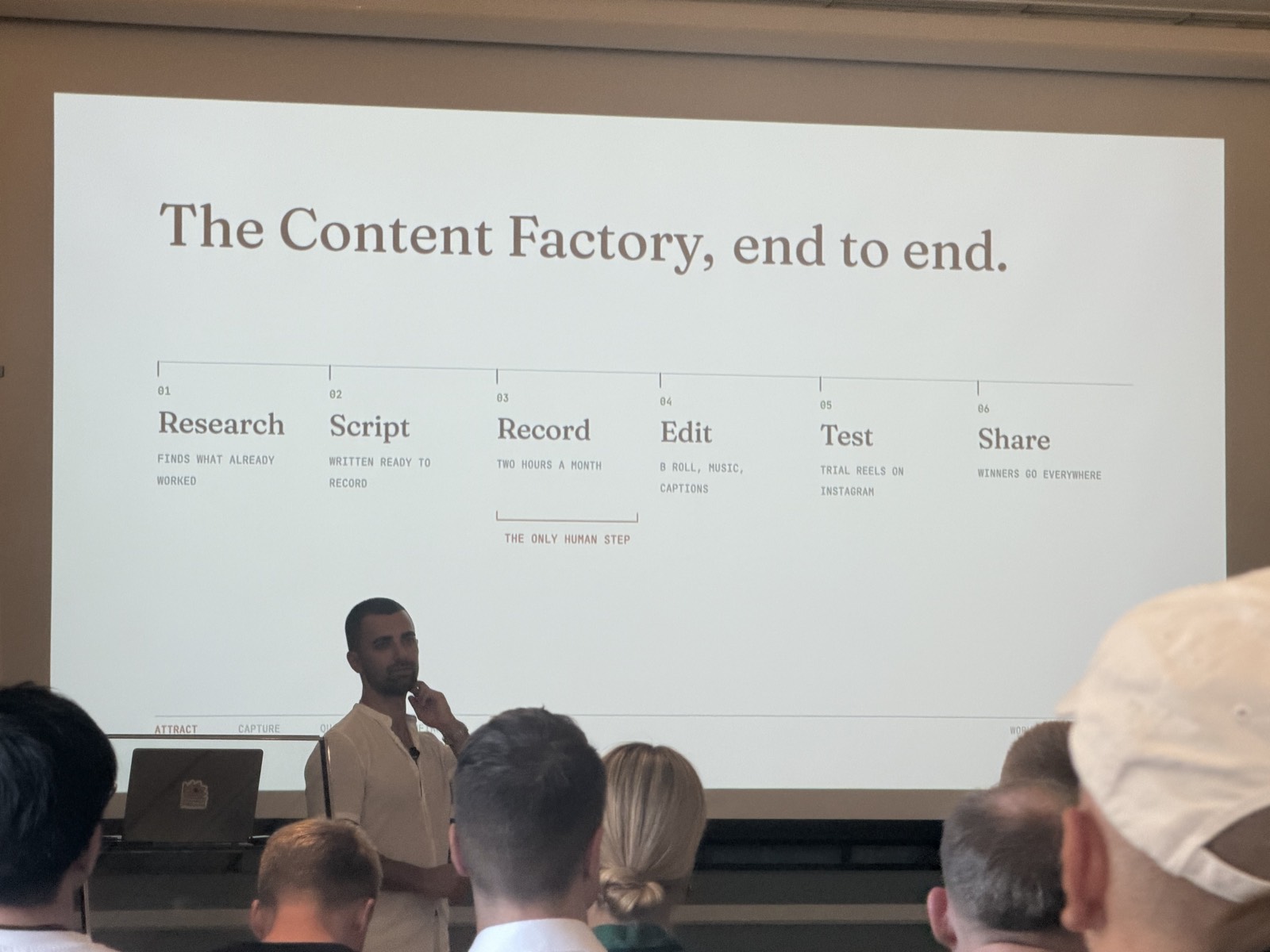
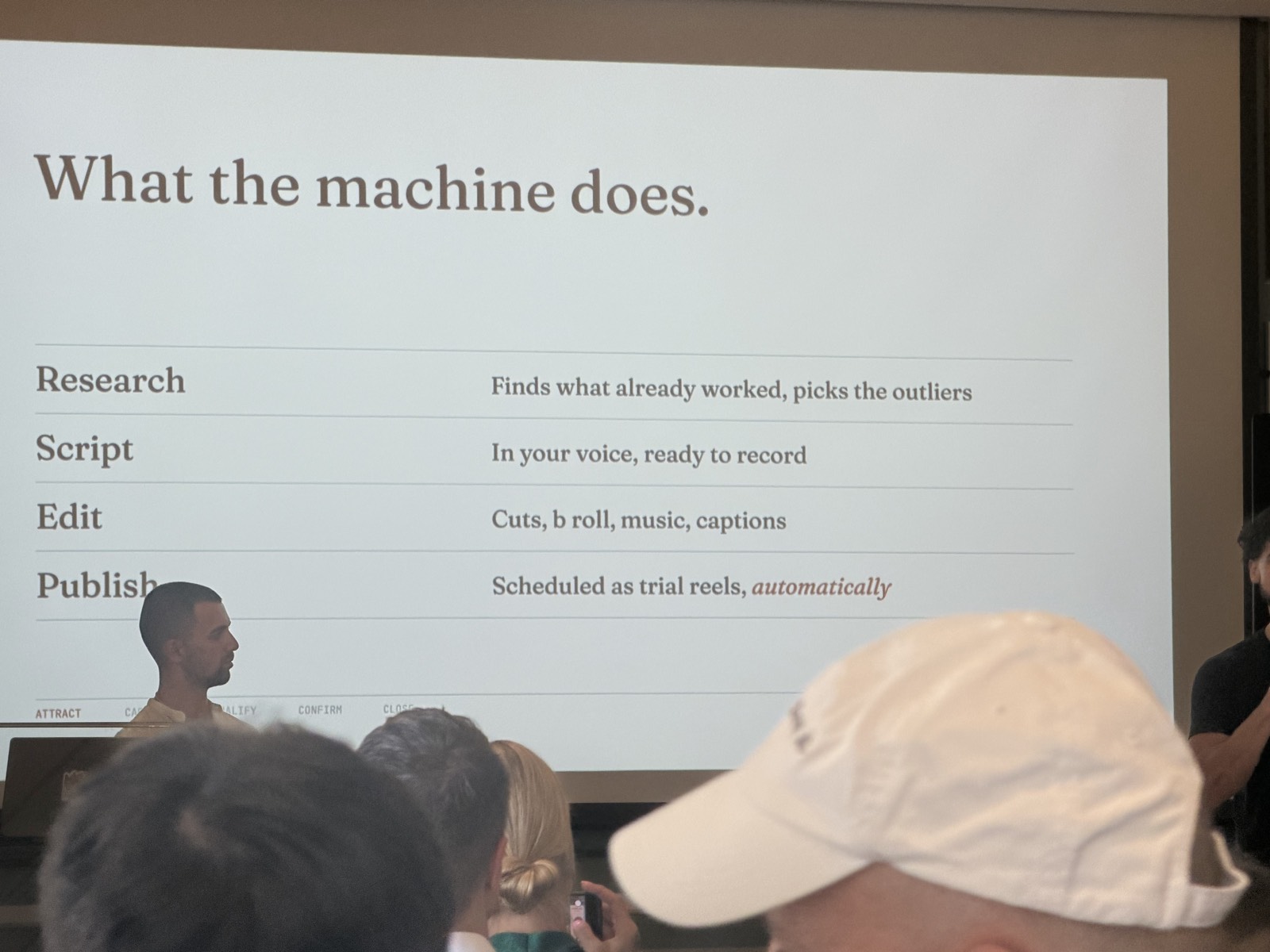
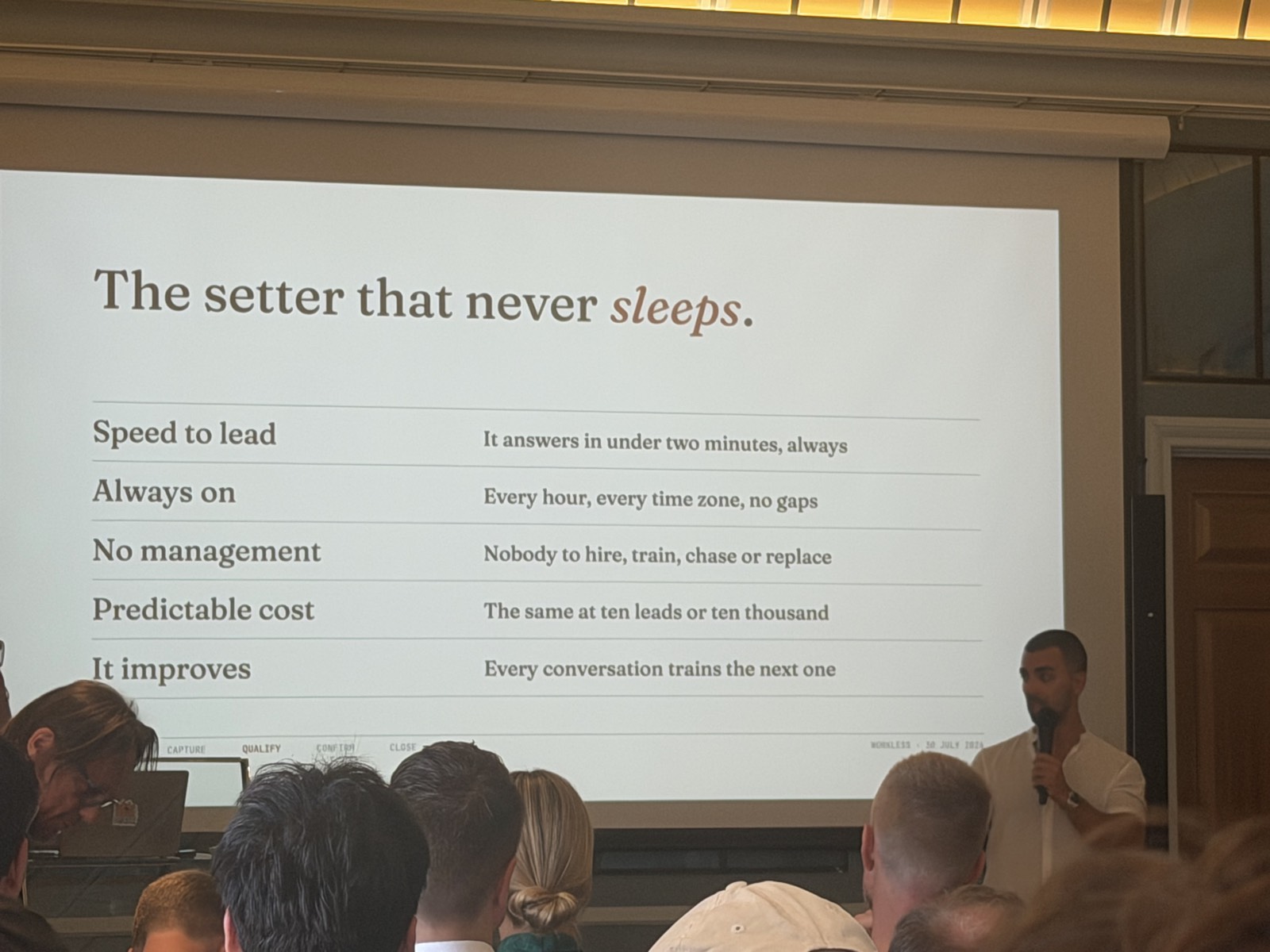
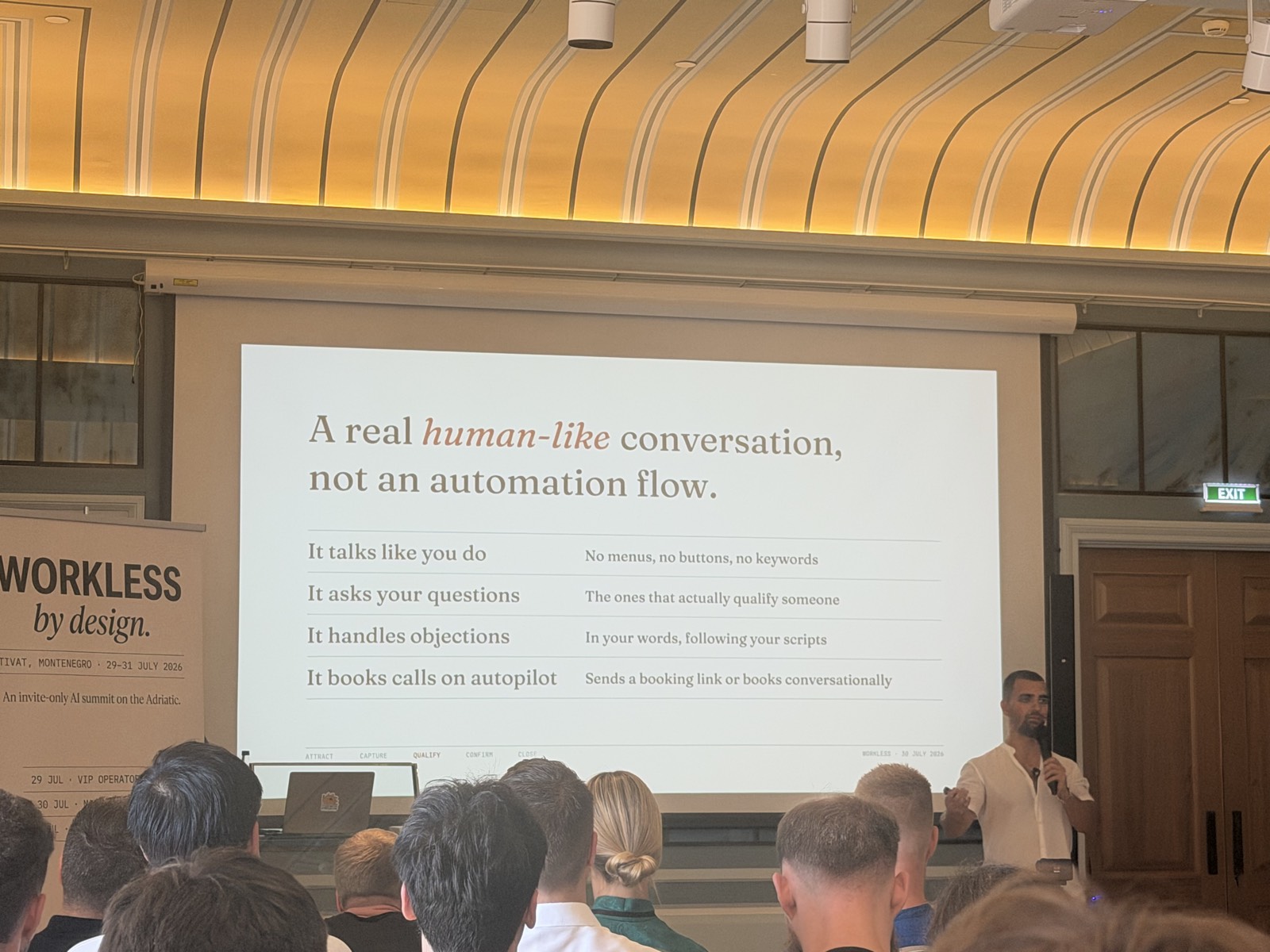
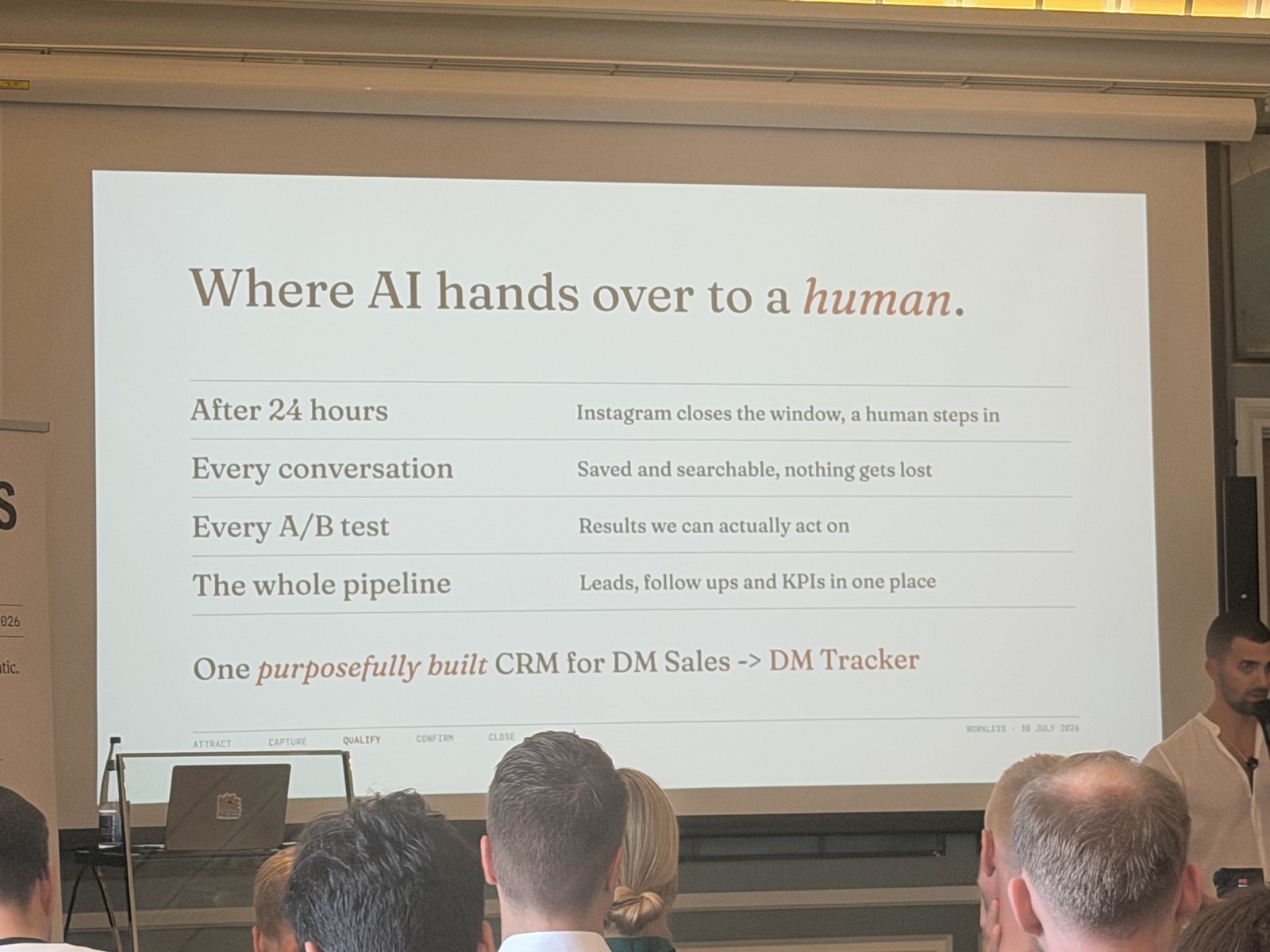
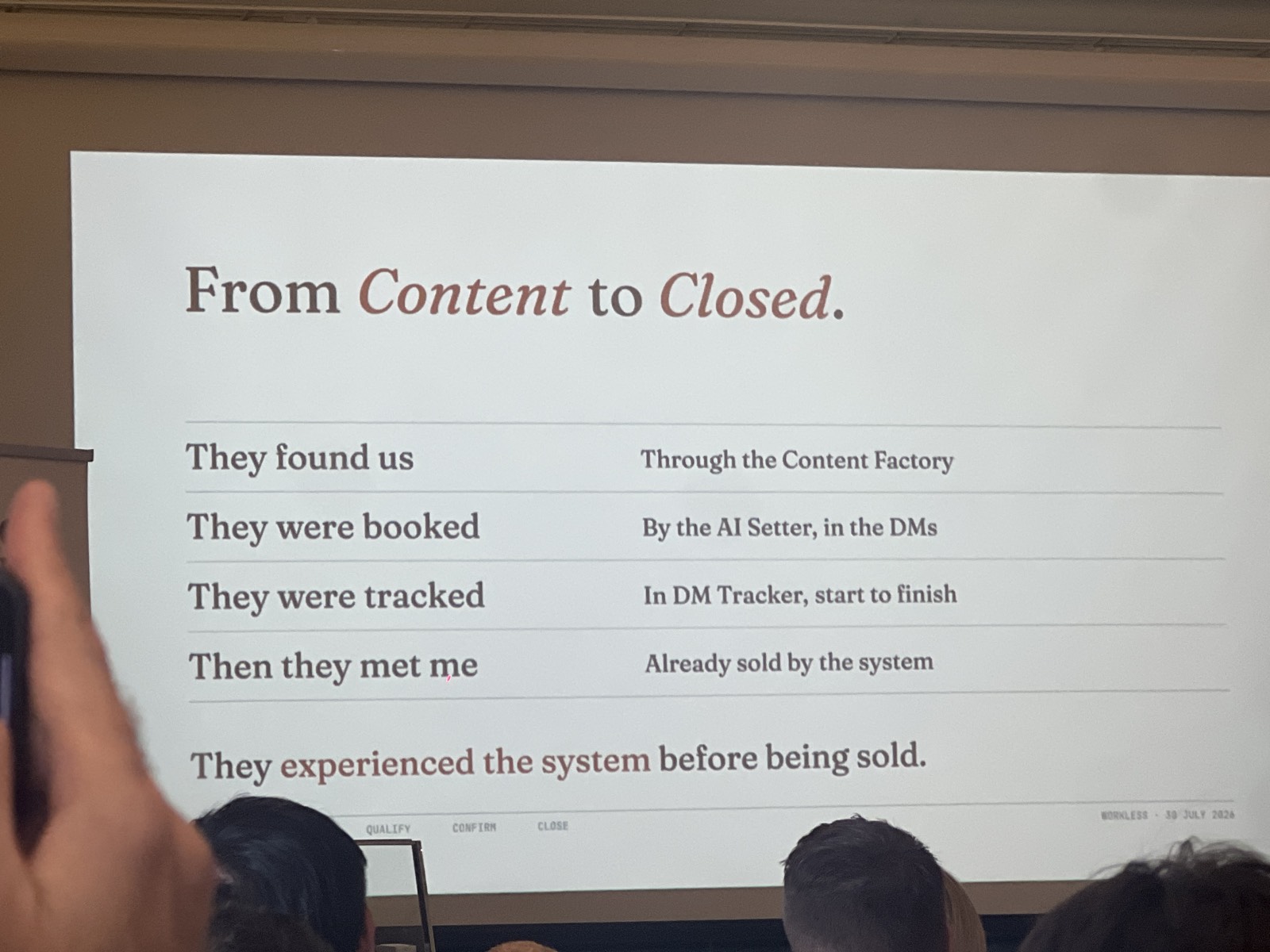
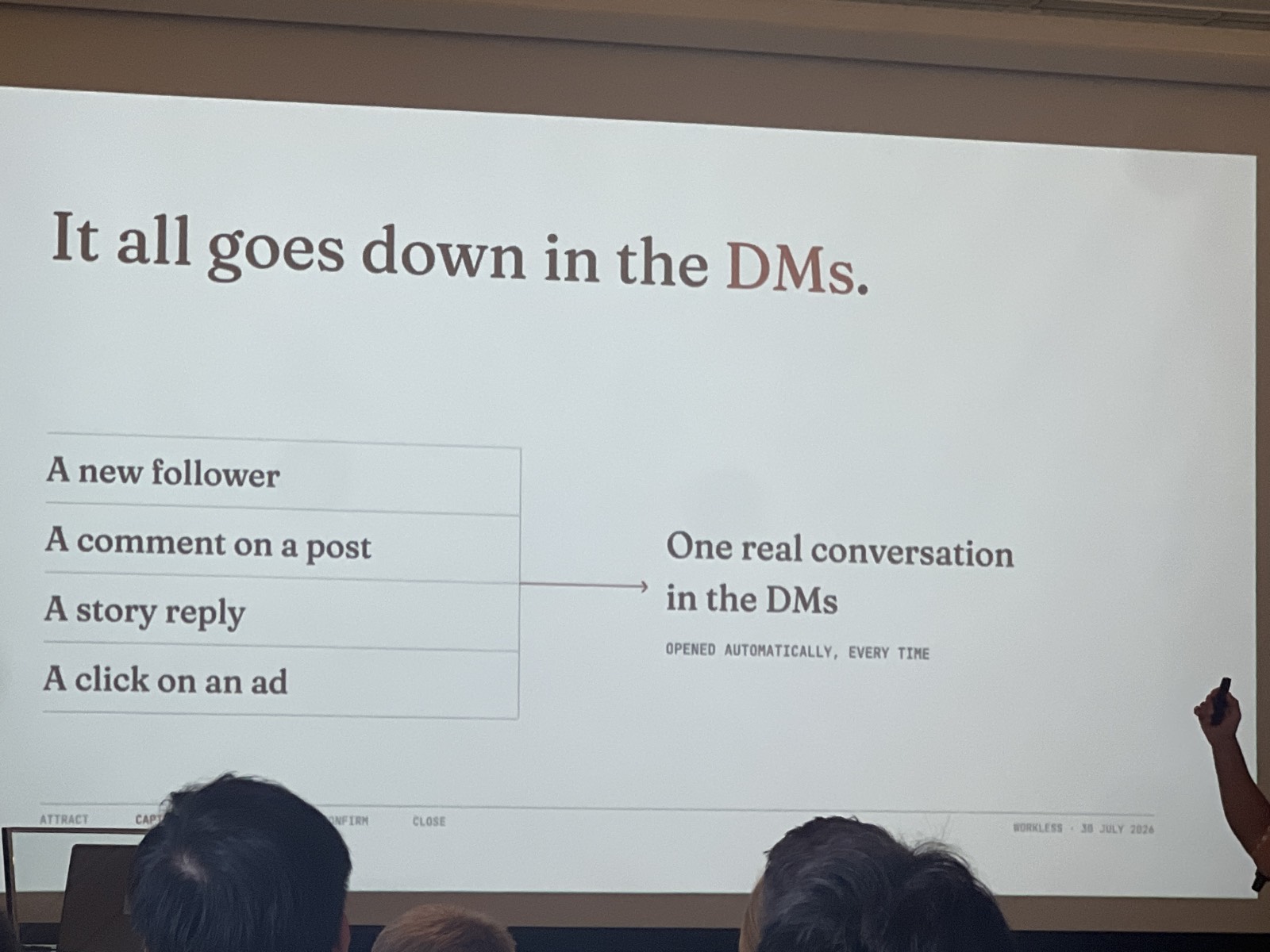
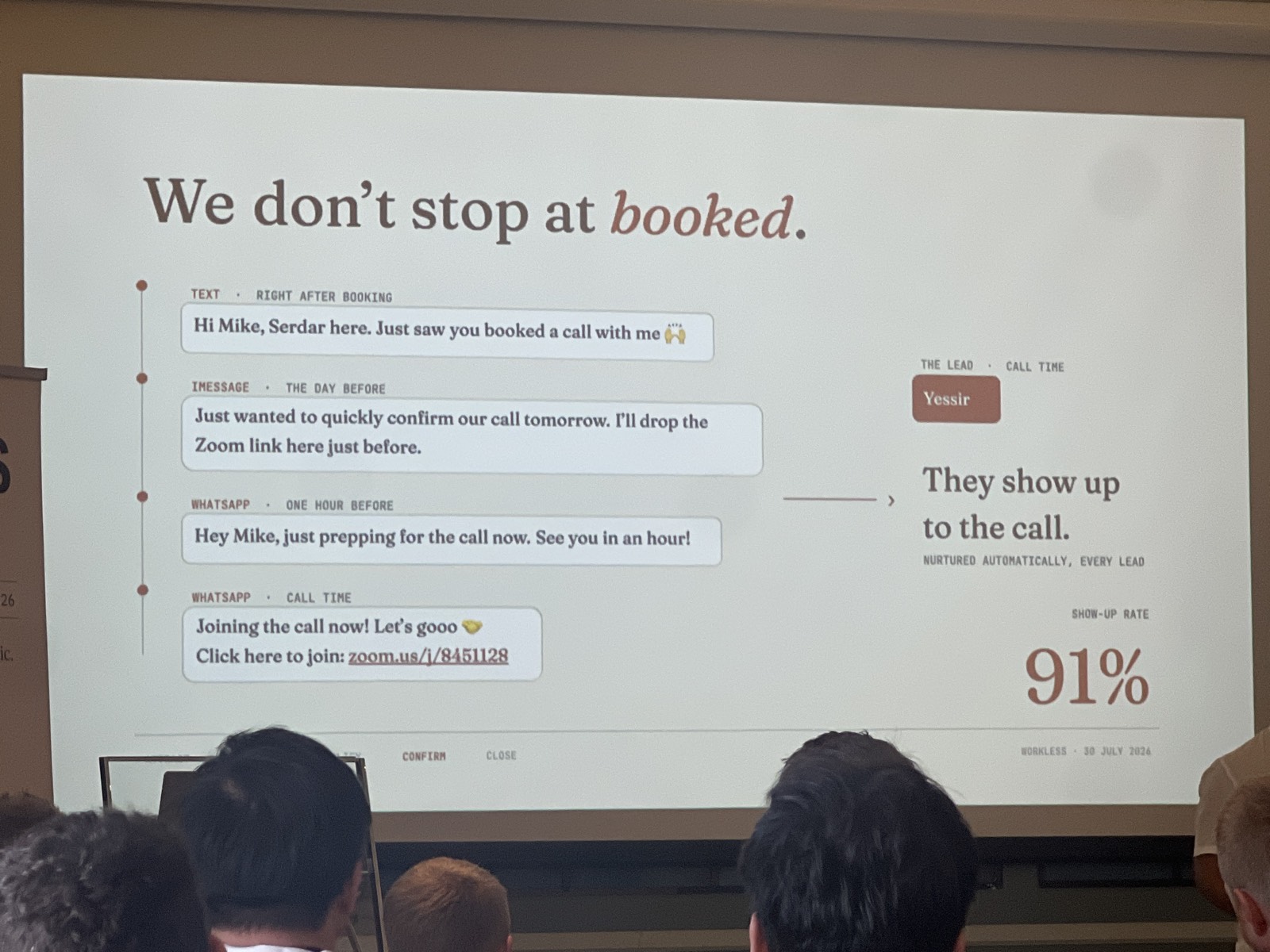
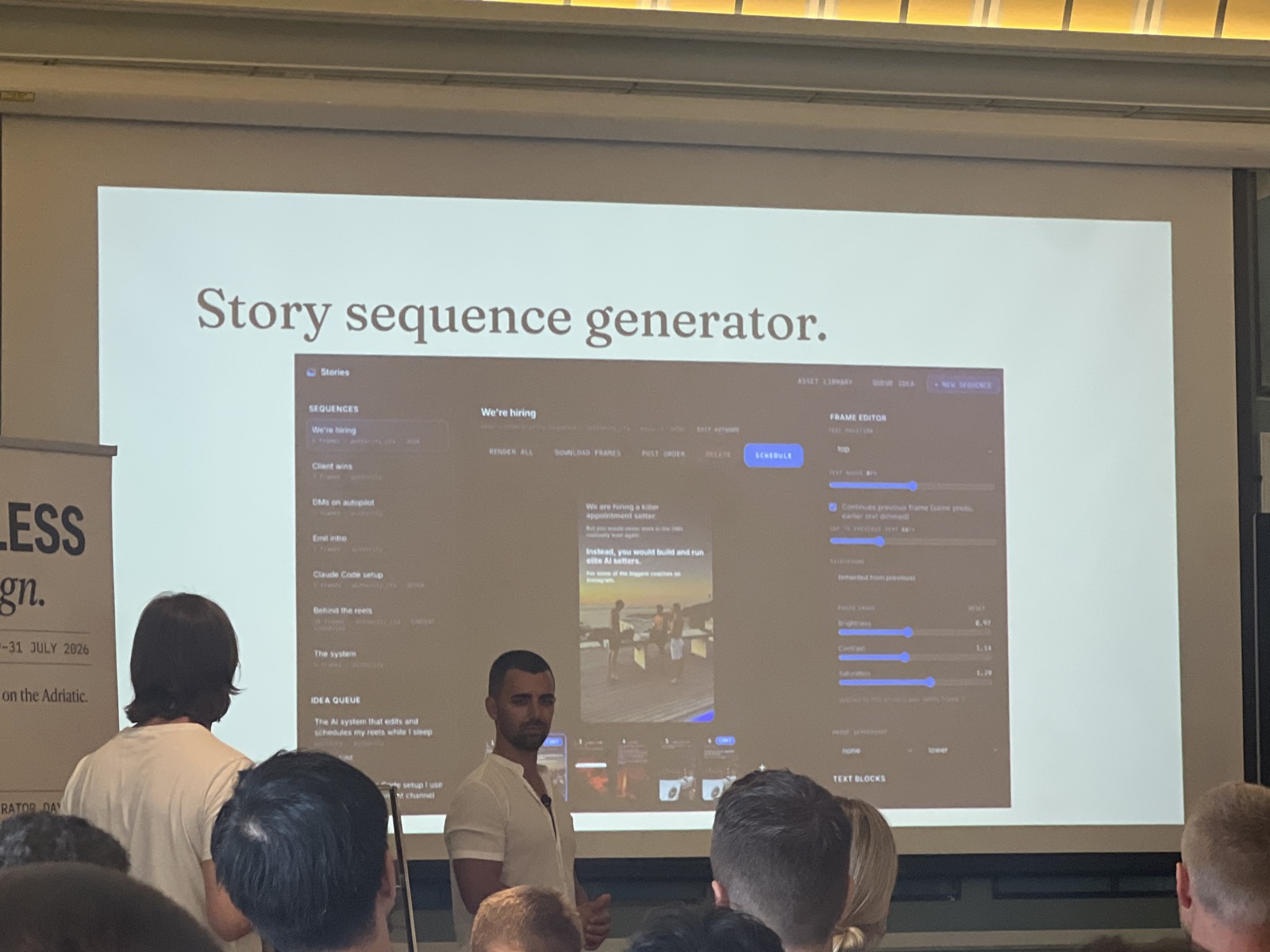
Two co-founders of a done-for-you Instagram acquisition agency for high-ticket offers: a full-funnel machine with exactly two human touchpoints - recording content and taking the sales call. They shared a skills pack with attendees (check if received).
Key takeaways
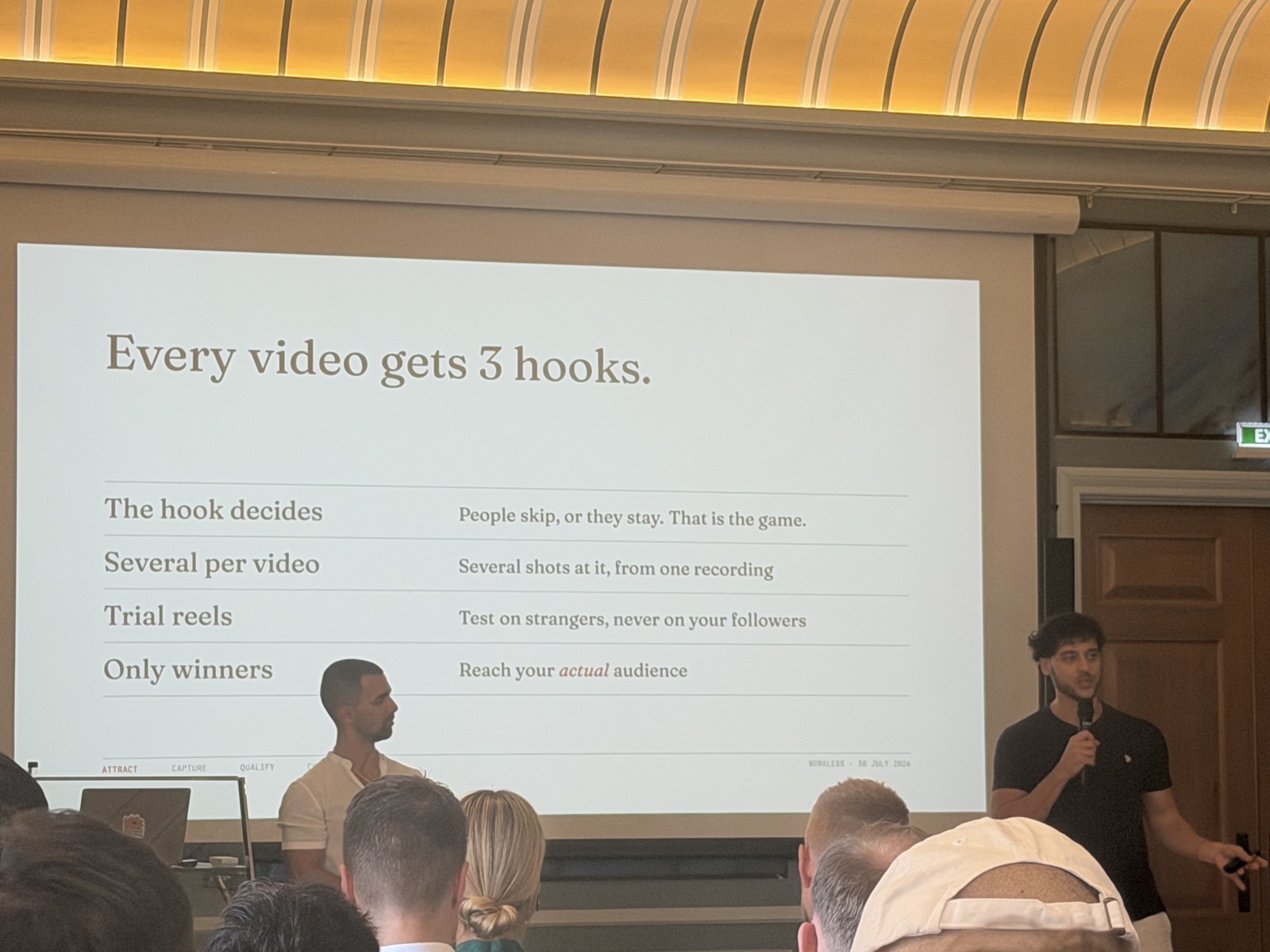
- Content factory: finds outlier competitor posts (5x average views), scripts in the founder's voice, A/B tests three hooks per video via Instagram trial reels before promoting the winner.
- Ads only amplify organic content that has already proven itself - never cold creative.
- AI DM setter: speed-to-lead under ~20 minutes, every engagement triggers a conversation; claims 99.6% of leads do not clock it is AI (UNVERIFIED).
- Where AI stops, the CRM hands a human a follow-up task (Instagram's 24-hour window) - deliberate AI-human fusion.
- The close: "You were here - the system you just experienced is what I'm selling."
Trial-testing and boost-only-proven-organic are directly usable for /ad-studio and the Deej/Meta play. Speed-to-lead physics is evidence for the 5-min response agent once DFE deliverability clears. The "you were here" close is ready-made for the Blueprint funnel.
Slides captured (10)
100k subs in 100 days with Claude
Samin Yasar Confirmed - schedule + slides
Samin messaged Matthew on Skool the same day - warm follow-up owed.
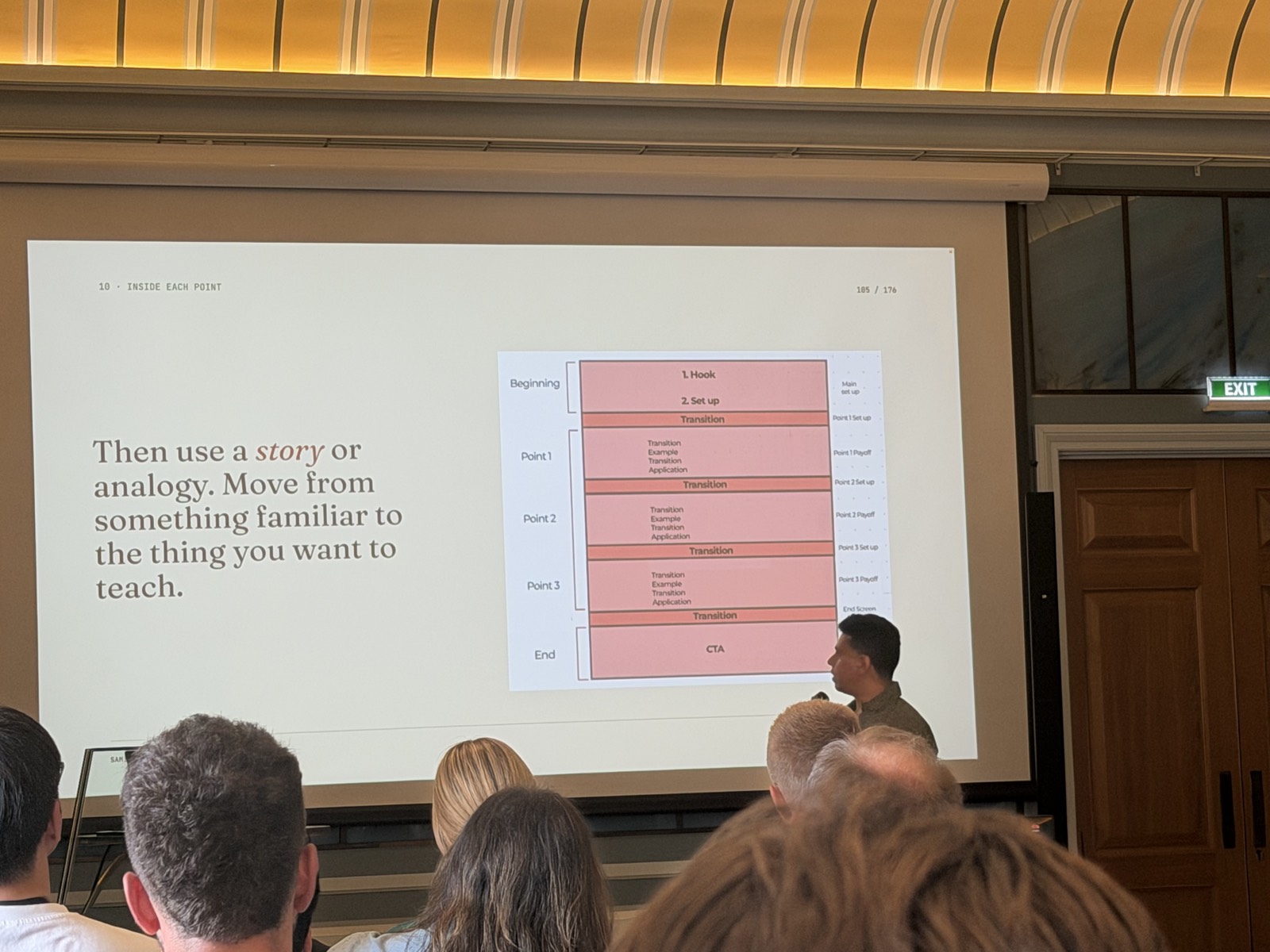
How he reached 100k YouTube subscribers in ~100 days (UNVERIFIED) and turned attention into clients without outbound: a three-level system that starts with pure consistency and keeps AI strictly in the organising seat.
Key takeaways
- Level 1 is consistency only: one video a week for ten weeks, quality explicitly not judged ("climb the cringy mountain"), enforced by forfeit-based accountability (miss a week = run 10km).
- Personal brand over company brand: "opportunities change but trust moves with you."
- Long-form first (the 7-11-4 trust rule); one long video repurposes into ~10 assets - "one unit of work, ten of distribution".
- Anti-slop filter: only make content you can teach without opening Google; 10 minutes daily writing 10 possible titles.
- AI organises, never writes: ramble first, let AI structure it into Hook / Setup / Points / CTA - scripts written BY AI sound like nobody.
The operating manual for the skill-sharing series: weekly cadence, ten weeks, no quality judgement, Matthew's personal profile as the primary channel. The ramble-then-AI flow is literally the existing Wispr workflow pointed at content.
Slides captured (1)
Extra profit from your existing content
Lauren Tickner and Dave Ebbelaar Confirmed - schedule
A live hot-seat: Lauren coaching Dave Ebbelaar (data-science YouTuber, ~EUR 1m/yr, UNVERIFIED) on decoupling bookings from weekly video performance. No slides captured.
The mid-funnel machine: a monthly live "training" (never say webinar) with one evergreen opt-in page and a rotating backend, a thank-you page that books sales calls BEFORE the event, AI-mined sales transcripts for real buying language, and LinkedIn's Services marketplace for passive inbound.
Key takeaways
- The thank-you page is the sales page: ICP headline, short pitch video, embedded calendar. KPI: 5-7% of opt-ins book a call from the thank-you page; the live event itself converts ~5%.
- Opt-in benchmarks: 20-25% cold, 35-40% warm organic (all UNVERIFIED).
- Mine closed-won sales-call transcripts with AI for the language that actually made buyers buy - it becomes titles, hooks and page copy.
- Never say "webinar" - call it a training; title = the audience's deepest current fear.
- LinkedIn Services marketplace: list services, post on the topic, inbound arrives from OUTSIDE your network (claims 4-5 leads, UNVERIFIED).
- Repurposing rule: write for the prospect's awareness level, not the client's - hook + literal bullets + one golden nugget.
Upgrade the Blueprint funnel confirmation page from "thanks" to pitch + booking CTA; the monthly-training machine is the launch engine for the £497 course and the Deej community play; mining the Ryan/Globex closed-won transcripts is nearly free. Lauren offered a webinar-builder skill ("just find me").
Still relevant next year
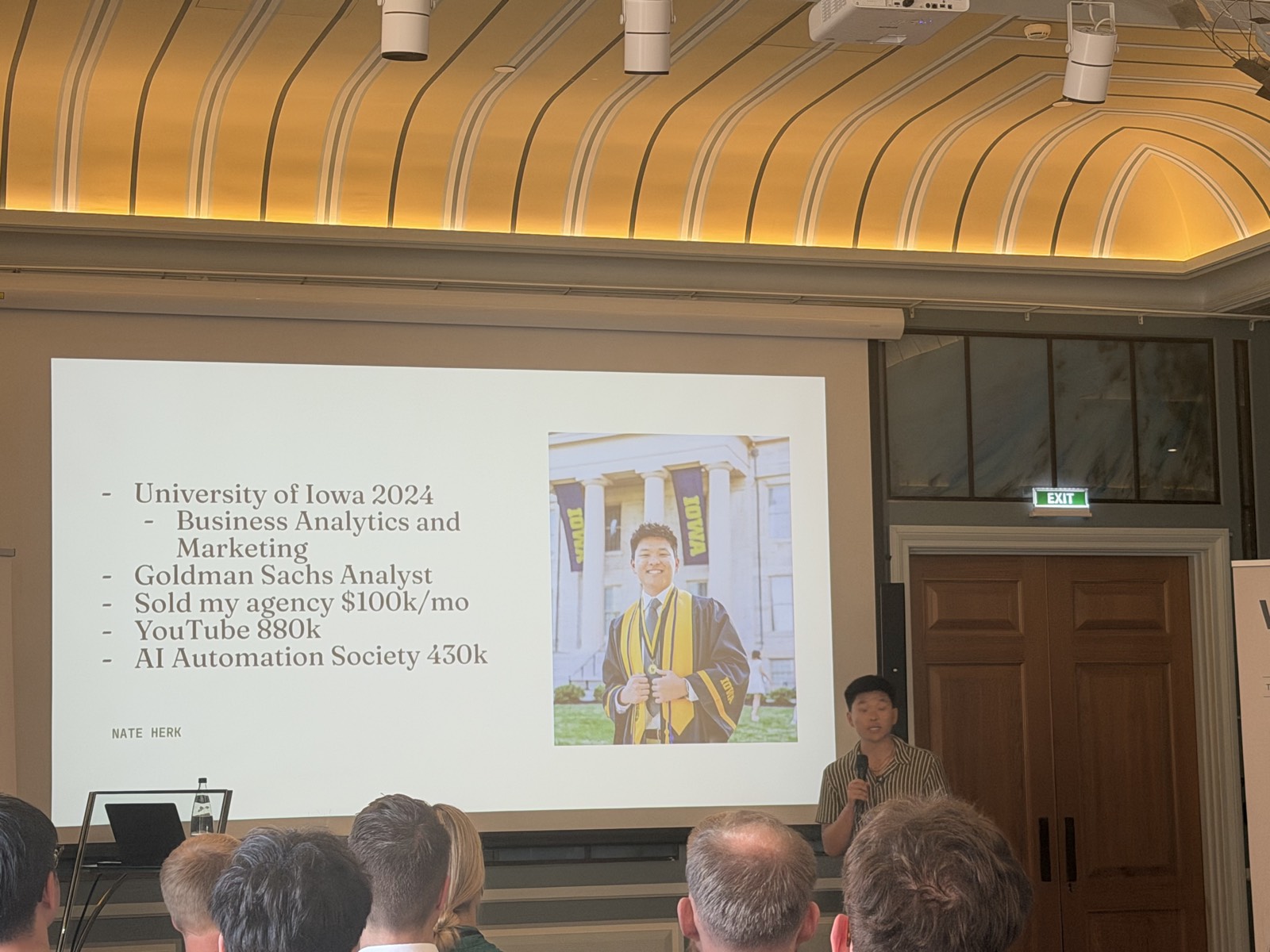
Nate Herk Confirmed - schedule + slides
His pricing masterclass handout is in the KB resources folder.
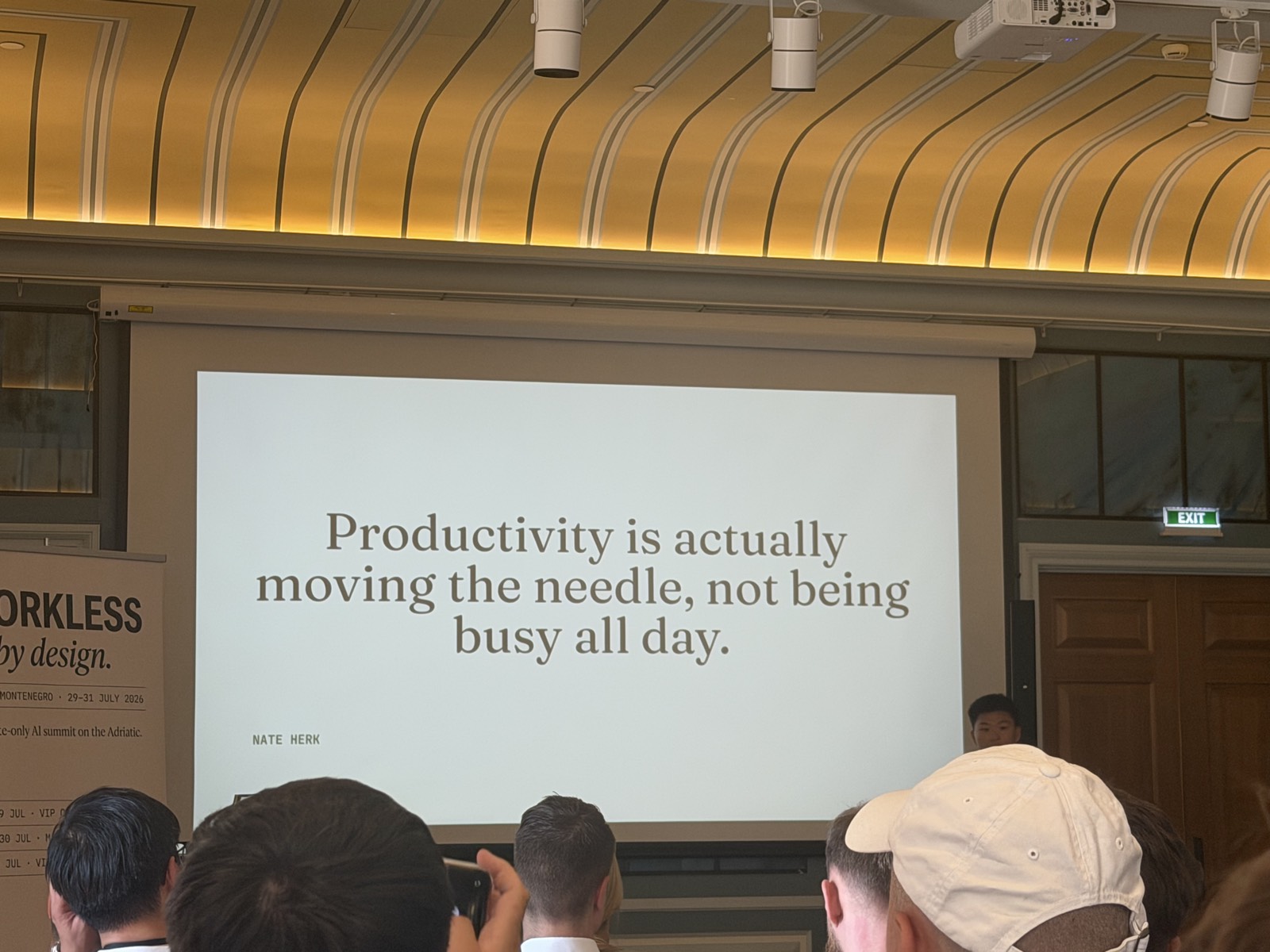
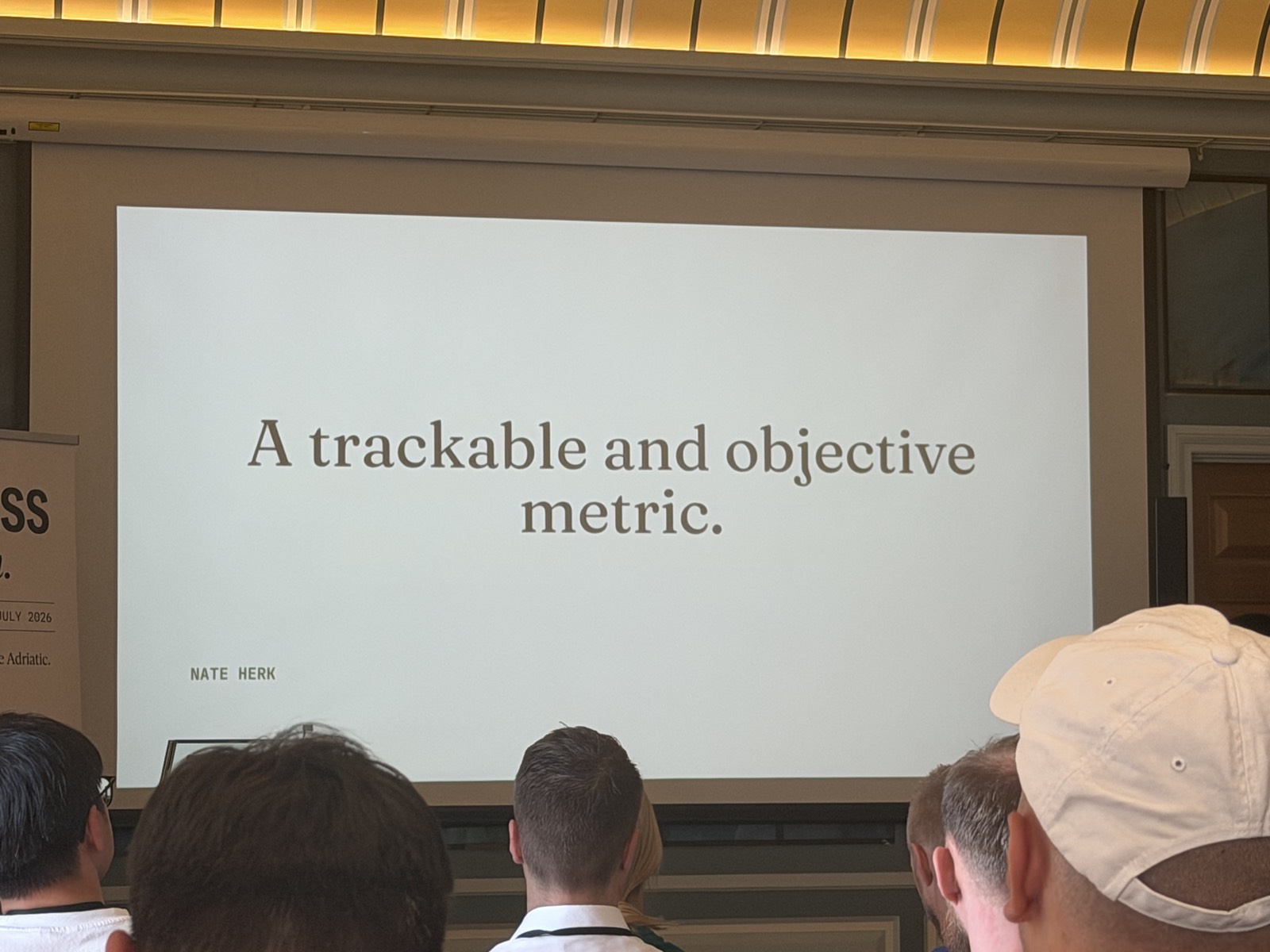
The most commercially relevant talk of the day: how AI consultants should diagnose the real constraint, agree one objective KPI before building, and price on value - roughly 10% of projected annualised year-one value, so the client sees a 10x ROI path.
Key takeaways
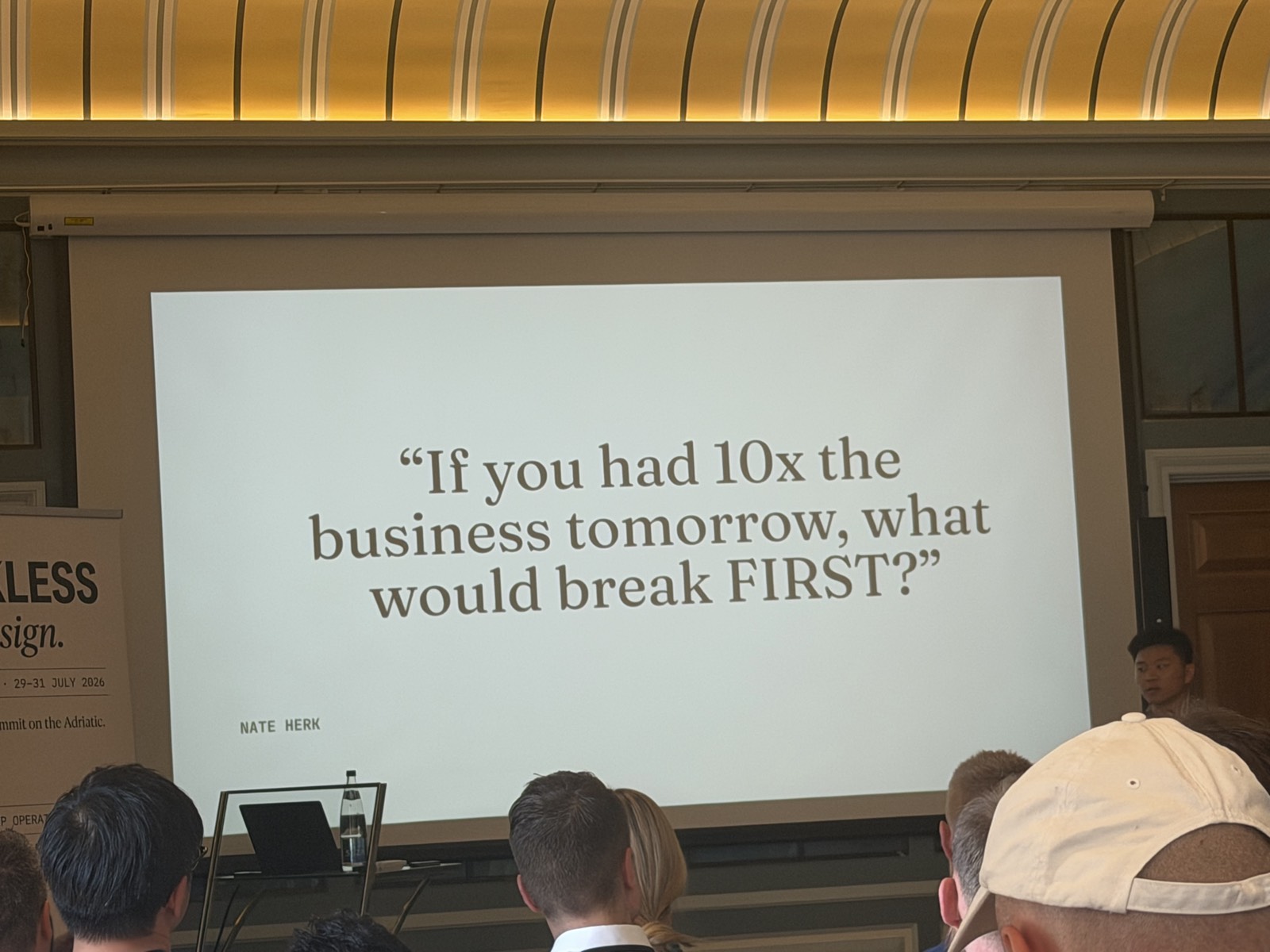
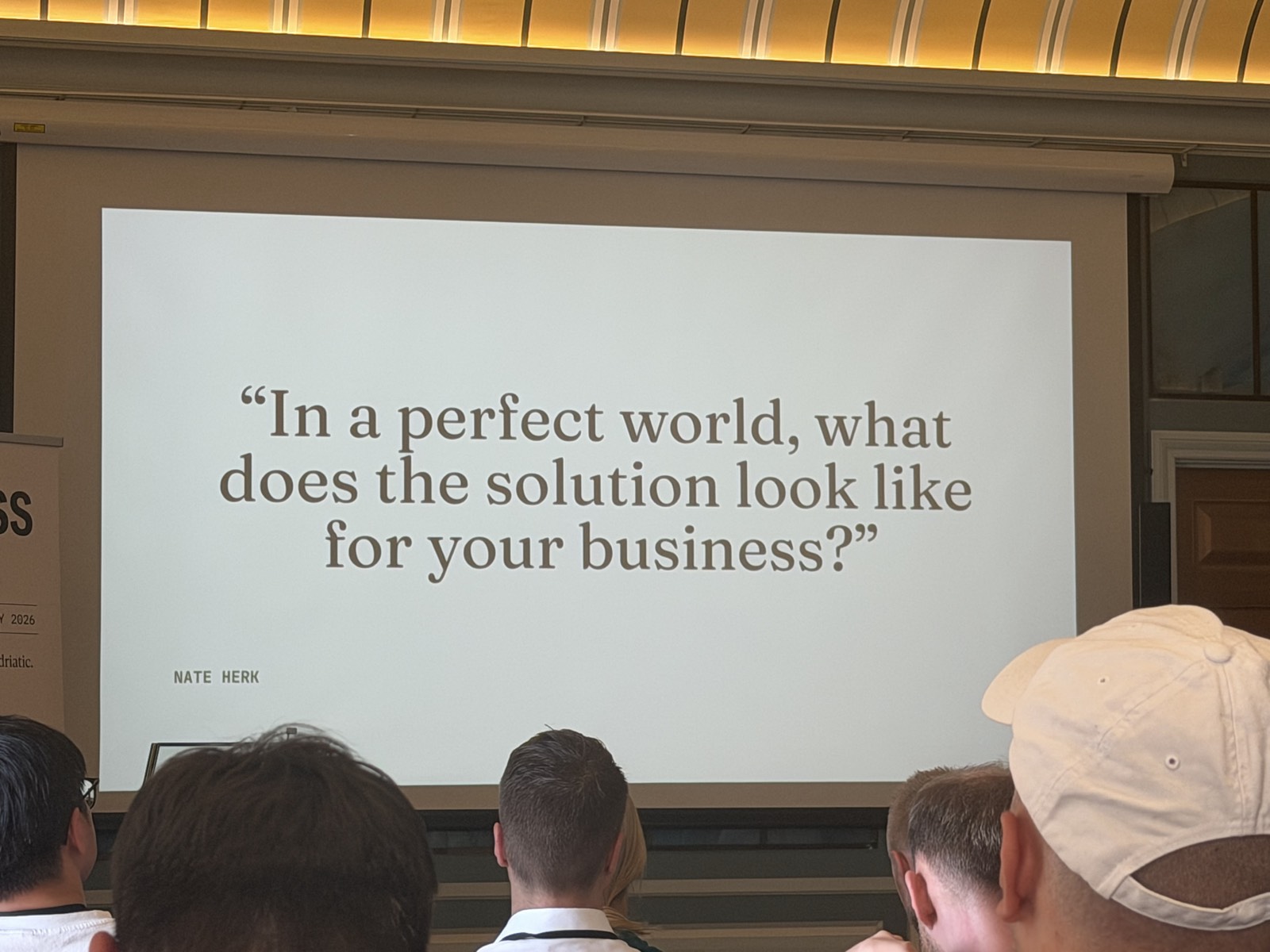
- Clients buy belief, not value: diagnose the real constraint, not the request. His med spa example: she asked for lead gen; the leak was no-shows and zero follow-up.
- Two discovery questions, each followed by deliberate silence: "If you had 10x the business tomorrow, what would break FIRST?" and "How do you get 10x the water into your pipe tomorrow?"
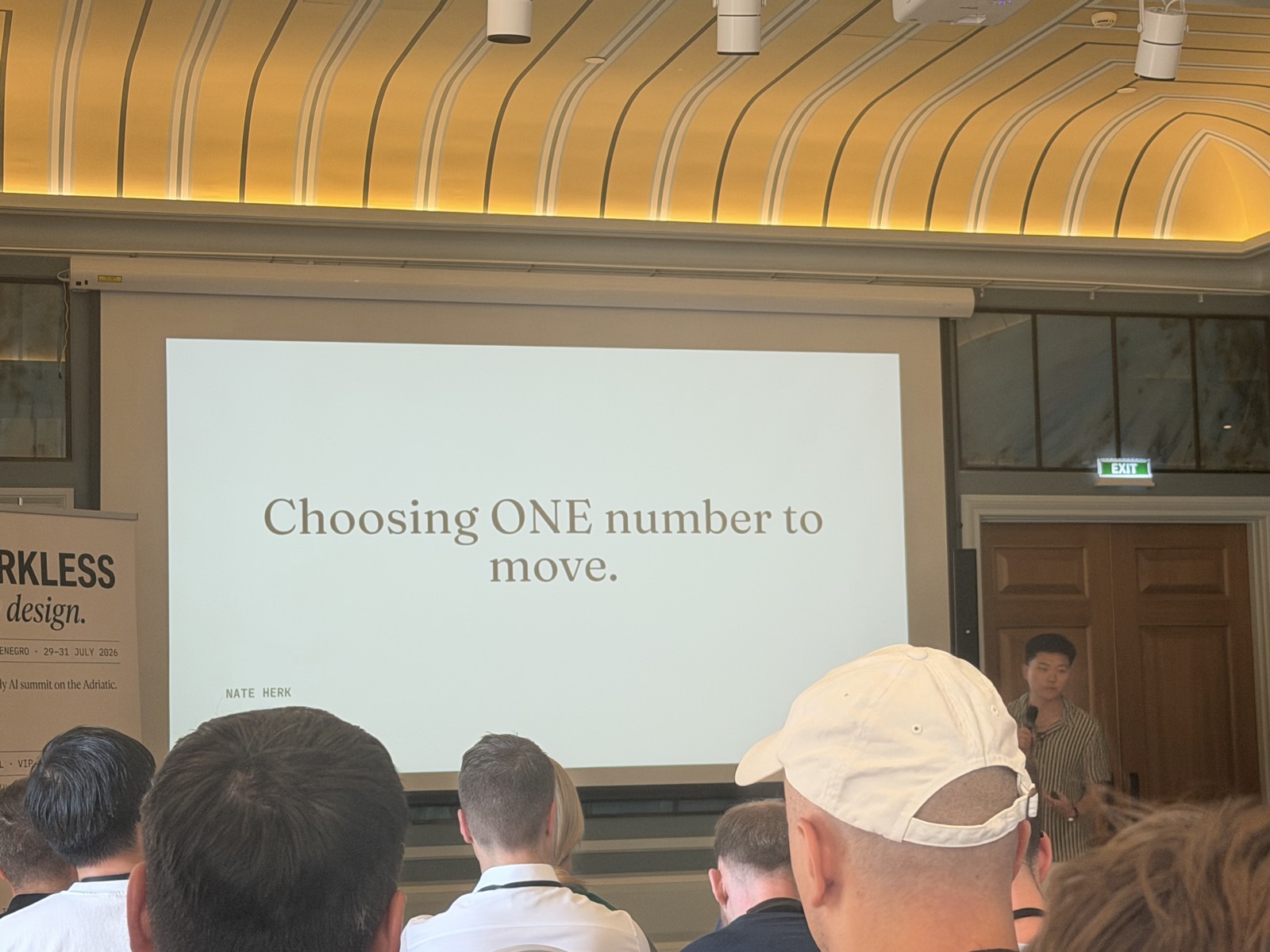
- Agree ONE objective KPI (baseline + target) before building - "feeling less busy" is unprovable; "5 appointments/week to 10" is defensible.
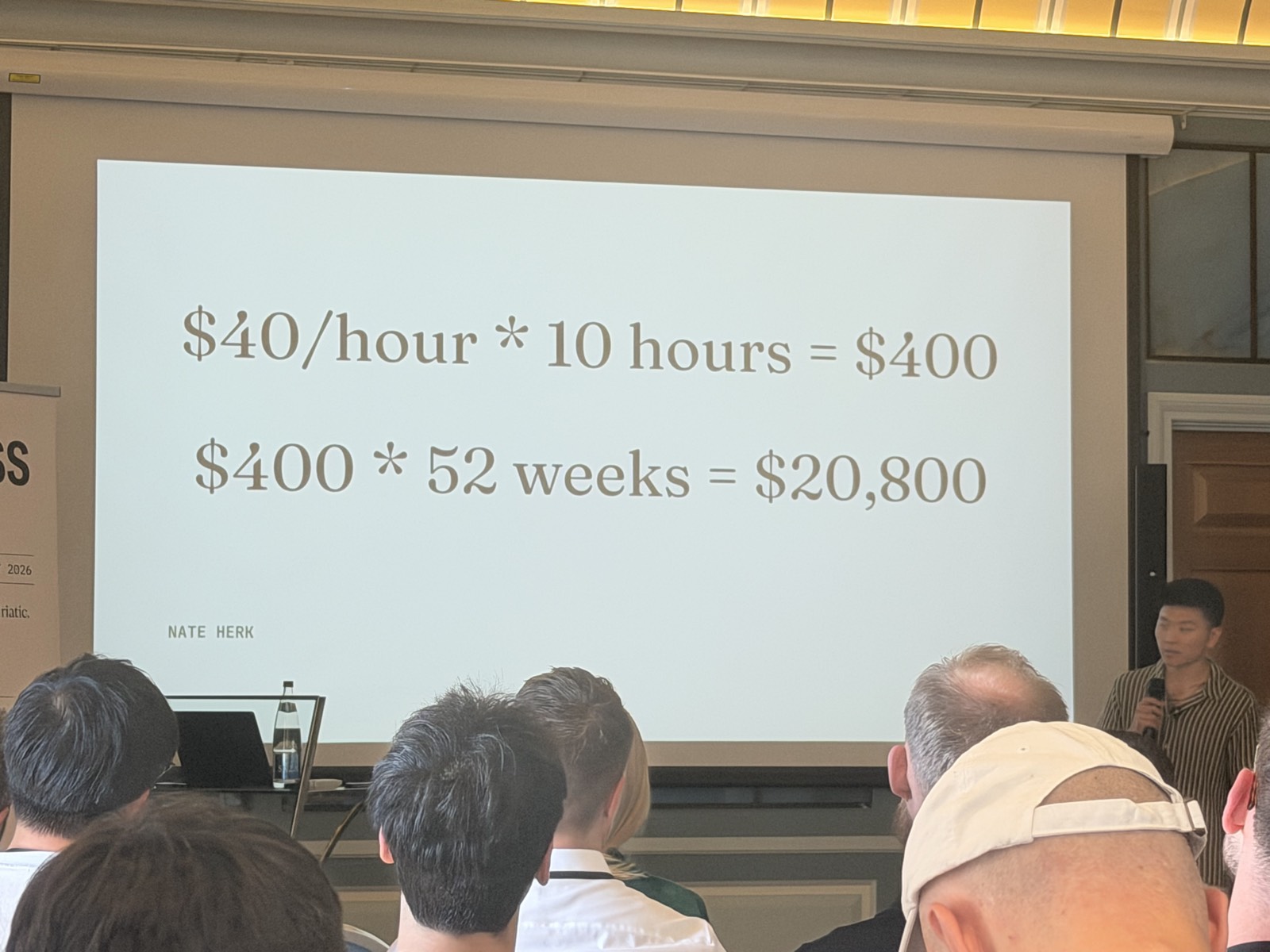
- Pricing: ~10% of annualised year-one value. Worked maths on the slide: $40/hour x 10 hours x 52 weeks = $20,800 value, so price ~$2,080. Walk the maths confidently, then silence.
- Never discount - slice scope instead: define a v1 that fits the budget at full rate and phase the rest. Discounting on first pushback teaches clients to push.
- Retainer path: return at months 1, 2, 3 with the agreed number moved - objectivity converts a project into a retainer.
Feed the KPI-baseline discipline straight into the Liberty pilot design (baseline every adviser pre-install; that proof prices the national royalty). The two discovery questions and the scope-slice rule go verbatim into the Blueprint call script and sales deck. The 10% maths justifies the held install price.
Slides captured (7)
Special announcement
- Not recorded
Closing announcement. Not recorded. The day continued with dinner at sea (18:00-21:00, boat from Port Pine, Tivat); the evening conversations are documented separately and privately.
Speaker resources collected
Held in the knowledge base (research/workless-ai-2026/resources/). Third-party files - reference only.
AIOS-Workspace.zip
Liam Ottley
His starter AI-workspace handout: context files, plans, a ledger and a /document command. Competitive intel - a stripped-down version of the Limitless install; read for what he includes and omits.
exit-opportunities-aios.zip
Ethan Monkhouse
A complete Claude skill: valuation framework, readiness checklist, buyer-and-deal paths, opportunity scorecard. A candidate to run against Limitless itself.
How to Price AI Solutions: The Complete Masterclass (docx)
Nate Herk
His value-based pricing masterclass - the companion document to the strongest talk of the day.